Summary

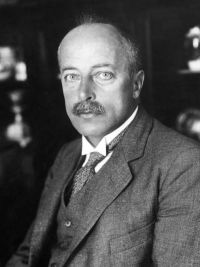
Portrait of Max von Laue Max von Laue On an Experiment on the Optics of Moving Bodies

The experiment is performed in air, which goes along with the motion of the earth. All parts of the arrangement, including air, preserve their position with each other constantly; so no influence of the motion is present, but Δτ = 0. Since in a system moving like a rigid body, all electromagnetic processes happen as if they are at rest.
Thus we see that all theories which seriously come into consideration for the optics of moving bodies - that of Hertz never belonged to them because of Fizeau's interference experiment on the entrainment of light - agree as to the effect in question.
Source: Wikisource

Portrait of Max von Laue Max von Laue On an Experiment on the Optics of Moving Bodies

Imagine the plane of the experiment at any point on the earth tangentially to it. The time dt required by light to traverse the distance ds (measured on earth) is extended by , if ds is moving with velocity . Consequently, the propagation time of the positively rotating ray is longer than in the case of vanishing rotation, and smaller for the negatively rotating ray by the same amount.
Source: Wikisource

Portrait of Max von Laue Max von Laue On an Experiment on the Optics of Moving Bodies

The experiment is aimed to bring a decision to the question (related to Stokes' theory) whether the aether next to earth joins its rotation or not. In the first case, no influence of rotation on the location of the middle interference fringe of same phase is expected, but in the second case we have to expect it. We want to see what can be expected as regards the various electrodynamic theories of moving bodies, whether the experiment could bring a decision between them.
Source: Wikisource

Get perspective with Kwize: daily news enlightened by great literature