Newtonian gravity

Definition and stakes

Museum of History and Technology,  Smithsonian Institution - United States National Museum - Bulletin 240

“ The theory of the gravity field of the earth was founded upon the laws of motion and the law of gravitation by Isaac Newton in his famous Principia (1687) . It follows from the Newtonian theory of gravitation that the acceleration of gravity as determined on the surface of the earth is the resultant of two factors: the principal factor is the gravitational attraction of the earth upon bodies, and the subsidiary factor is the effect of the rotation of the earth. ”
Source: Gutenberg

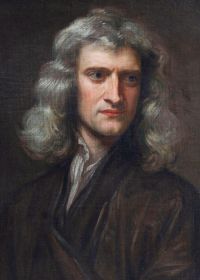
Portrait of Isaac Newton Isaac Newton,  The Mathematical Principles of Natural Philosophy…

“ All spaces are not equally Full. For if all spaces were equally full, then the specific gravity of the fluid which fills the region of the air, on account of the extreme density of the matter, would fall nothing short of the specific gravity of quick-silver, or gold, or any other the most dense body; and therefore, neither gold, nor any other body, could descend in air. For bodies do not descend in fluids, unless they are specifically heavier than the fluids. And if the quantity of matter in a given space, can, by any rarefaction, be diminished, what should hinder a diminution to infinity? ”
Source: Wikisource

Miscellanea Curiosa, Vol. 1

“ Newton has shewn in his Principia Philosophiæ, it will follow, that according to the general Principle of Gravity, visible throughout the whole Universe, all those Particles that by length of time, or otherwise, shall moulder away, or become loose on the Concave Surface of the External Sphere, would fall in, and with great force descend on the Internal, unless those Particles were of another sort of Matter capable by their stronger tendency to each other, to suspend the force of Gravity ”
Source: Gutenberg

Get perspective with Kwize: daily news enlightened by great literature