Summary

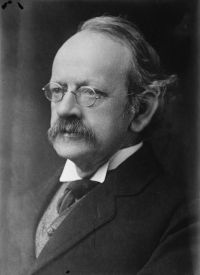
Portrait of Joseph John Thomson Joseph John Thomson On the Electric and Magnetic Effects produced by the Motion of Electrified Bodies (1881)

According to Weber's law, the force does not depend on the actual velocities of the particles, but only on their velocity relative to each other, whereas, according to the laws we have investigated, the forces depend on the actual velocities of the particles as well as on their relative velocities: thus there is a force between two charged particles moving with equal velocities in the same direction, in which case, of course, the relative velocity is nothing.
Source: Wikisource

Portrait of Joseph John Thomson Joseph John Thomson On the Electric and Magnetic Effects produced by the Motion of Electrified Bodies (1881)

The charged sphere will produce an electric displacement throughout the field; and as the sphere moves the magnitude of this displacement at any point will vary. Now, according to Maxwell's theory, a variation in the electric displacement produces the same effect as an electric current; and a field in which electric currents exist is a seat of energy; hence the motion of the charged sphere has developed energy, and consequently the charged sphere must experience a resistance as it moves through the dielectric.
Source: Wikisource

Portrait of Joseph John Thomson Joseph John Thomson On the Electric and Magnetic Effects produced by the Motion of Electrified Bodies (1881)

Let a be the radius of the moving sphere, e the charge on the sphere, and let us suppose that the sphere is moving parallel to the axis of x with the velocity p; let ξ, η, ζ be the coordinates of the centre of the sphere; let f, g, h be the components of the electric displacement along the axes of x, y, z respectively at a point whose distance from the centre of the sphere is ρ, ρ being greater than a.
Source: Wikisource

Get perspective with Kwize: daily news enlightened by great literature