Summary

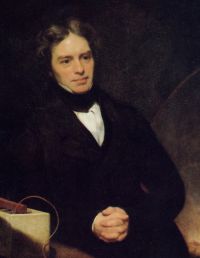
Portrait of Michael Faraday Michael Faraday Experimental researches in electricity…

In order to procure a reference to _chemical action_, the wires were now retained immersed in the acid to the depth of five eighths of an inch, and the needle, when stationary, observed; it stood, as nearly as the unassisted eye could decide, at 5-1/3 division. Hence a permanent deflection to that extent might be considered as indicating a constant voltaic current, which in eight beats of my watch (369.) could supply as much electricity as the electrical battery charged by thirty turns of the machine.
Source: Wikisource

Portrait of Michael Faraday Michael Faraday Experimental researches in electricity…

The battery of fifteen jars was then charged by sixty revolutions of the machine, and discharged, as before, through the galvanometer. The deflection of the needle was now as nearly as possible to the eleventh division, but the graduation was not accurate enough for me to assert that the arc was exactly double the former arc; to the eye it appeared to be so. The probability is, that _the deflecting force of an electric current is directly proportional to the absolute quantity of electricity passed_, at whatever intensity that electricity may be [A] .
Source: Wikisource

Portrait of Michael Faraday Michael Faraday Experimental researches in electricity…

At p. 173, the author, when describing this experiment, says, "The mobile circle turns to take a position of equilibrium as a conductor would do in which the current moved in the _same direction_ as in the spiral;" and in the same paragraph he adds, "It is therefore proved _that a current of electricity tends to put the electricity of conductors, near which it passes, in motion in the same direction._" These are the words I quoted in my paper (78.) .
Source: Wikisource

Get perspective with Kwize: daily news enlightened by great literature