“ The fork bears the chief burden of responsibility, being used for everything solid or semi-solid, leaving the spoon to the limited realm of soft custards and fruits that are so juicy as to elude the tines of the fork. ”
Fork
Definition and stakes
A fork is a utensil primarily used for handling solid or semi-solid foods, complementing the knife and spoon in dining practices. Authors have examined its role and symbolism in various contexts: Agnes H. Morton highlights its practical function in eating, while Knut Hamsun emphasizes its essential role alongside the knife.
William Carew Hazlitt traces its historical emergence, noting its presence in royal inventories. These perspectives reveal the fork’s transformation from a luxury item to a staple of modern tableware, reflecting broader changes in etiquette and social norms. The fork’s dual purpose and cultural importance underscore its lasting presence in both daily life and literary discussion.
Quotes about “fork”
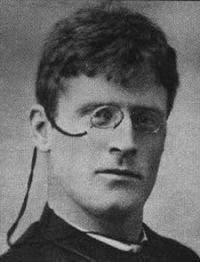 Knut Hamsun,
Growth of the Soil — Book One, Chapter XVII
(1917)
Knut Hamsun,
Growth of the Soil — Book One, Chapter XVII
(1917)
“ And it was not for nothing he had been living with companions of another sort. He had grown to be more sensitive and finer feeling than ever before. He knew that a fork was really just as necessary as a knife. ”
The Stag Cook Book: Written for Men by Men
“ There is a dish—a gastronomical ecstasy—the faintest conception of which is magnificently beyond the pen. The fork is the one utensil that can convey to the uninitiated the unique, the utterly sublime flavor of Morels sauté. ”
William Carew Hazlitt, Old Cookery Books and Ancient Cuisine… (1902)
“ Forks, though not employed by the community, became part of the effects of royal and great personages, and in the inventory of Charles V. of France appear the spoon, knife, and fork. In another of the Duke of Burgundy, sixty years later (1420) , knives and other implements occur, but no fork. ”

“ Instance the absurdity of taking the fork under the thumb with the forefinger pressing along the back of the wobbly instrument, when any one could see that the proper, natural way of using a fork was to grasp it daggerwise and drive it firmly through that skidding piece of meat. ”
| override_editor, Encyclopædia Britannica, Ninth Edition (1888)
“ TUNING FORK, a small bar of cast tool steel with tolerably defined edges, bent into a fork with two prongs. A handle of the same metal extending from the bend of the fork serves as a sound-post to transmit the vibrations of the fork to any resonance board or body convenient for reinforcing the sound. The fork is set in vibration by striking one of the prongs against any hard substance, by pressing the prongs together if the fork is a light one, or, if it is large, by drawing a double bass bow across one of the prongs. ”
Thomas Thalric Harman, Showell's Dictionary of Birmingham… (1885)
“ Later on, when the coaches began to throng the road, gentlemen were in the habit of carrying with them their own knife and fork for use, so seldom were the latter articles to be found at the country inns, and the use of forks cannot be said to have become general more than a hundred years ago. ”
Anne Knox Arthur, An embroidery book (1920)
“ Two-pronged Fork.—A very quickly worked insertion, fringe, or edging may be made by means of a two-pronged fork. The little implement can be manufactured quite easily at home. For a fringe, a wooden fork is necessary, with one wide and one narrow prong. The usual fork is of thick steel wire and varies in size, but as steel wire is too hard for the unskilled worker to [Pg 166] manipulate, a softer metal would be more satisfactory. ”
 Eliza Leslie,
The behaviour book
Eliza Leslie,
The behaviour book
“ It is fashionable to use your knife only while cutting up the food small enough to be eaten with the fork alone. While cutting, keep the fork in your left hand, the hollow or concave side downward, the fork in a very slanting position, and your fore-finger extended far down upon its handle. When you have done cutting up what you are going to eat, lay aside your knife, transfer the fork to your right hand, and take a small piece of bread in your left. If eating any thing soft, use your silver fork somewhat as a spoon, turning up the hollow side that the cavity may hold the food. ”
“ At all tables where four-tined forks are provided, the knife should be used only to divide the food, never to convey it to the mouth. For this purpose, we use either the fork, a spoon, or the fingers. ”
Ann Fraser Tytler, Common Sense for Housemaids
“ A knife, fork, or spoon, which has not been properly cleaned, cannot be taken into the hand without being discovered, and leaving a disagreeable impression; a visitor may not have the courage to send it away, but the comfort of his dinner is destroyed. Having cut some slices of bread rather thick, cut each slice into four, and with a fork, put a piece all round for each person, leaving the loaf in the room in case more may be required; when more is called for, hand some additional pieces in the bread-basket. ”
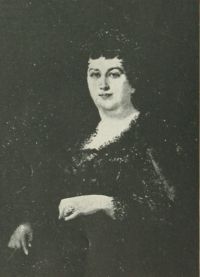 M. E. W. Sherwood,
Manners and Social Usages
M. E. W. Sherwood,
Manners and Social Usages
“ To take meat and vegetables and pack them on the poor fork, as if it were a beast of burden, is a common American vulgarity, born of our hurried way of eating at railway-stations and hotels. But it is an unhealthy and an ill-mannered habit. To take but little on the fork at a time, a moderate mouthful, shows good manners and refinement. The knife must never be put into the mouth at any time—that is a remnant of barbarism. ”
 George Washington,
Journal of my journey over the mountains
George Washington,
Journal of my journey over the mountains
“ The wealthy employed a person whose special duty it was to carve the meats into proper and convenient pieces and his was the only knife in the dining hall. When the fork was first introduced into England, its employment was ridiculed as an effeminate practice, as may be seen in the plays of Beaumont and Fletcher, and others where the persons using it are referred to as "your fork-carving-traveler." ”
 Charles Dickens,
The Pickwick Papers (Gutenberg edition…
Charles Dickens,
The Pickwick Papers (Gutenberg edition…
“ He had raised his fork to his lips, and was on the very point of opening his mouth for the reception of a piece of beef, when the hum of many voices suddenly arose in the kitchen. He paused, and laid down his fork. ”
George Washington,
Journal of my journey over the mountains
“ At the present day the idea of eating a meal at table without the accompaniment of a knife and fork would excite disgust; their absence, however, in a remote Virginia mountain cabin in 1747-8 as here recorded, simply shows that they had not been provided nor deemed essential to the life of a hunter, not an ignorance of their use, as the two-pronged, iron, table fork was in common use at that period throughout the settlements in all the American colonies. ”
Maud C. Cooke, Twentieth Century Culture and Deportment
“ The dinner table for home meals is laid very much after the fashion of the breakfast table with the omission of the server. If there is to be more than one course, such as a salad, another fork must be added, in which case it will be best to place the forks at the left of the plate. If there is fish, another extra fork, or else the appropriate little fish knife and fork, is demanded. If a fork only is used, the flakes of fish may be pushed upon the fork by means of a bit of bread. ”
 Lillian Eichler,
Book of Etiquette, Volume 2, Part 3…
(1921)
Lillian Eichler,
Book of Etiquette, Volume 2, Part 3…
(1921)
“ The knife and fork should never be held in the same hand together, and when not being used, one or both of the utensils should rest on the plate. They should never be allowed to rest against the edge of the plate with the handles on the table; when one is through with both the knife and fork, they should be placed entirely on the plate, their tips touching at the center, their handles resting against the edge. They are never placed back again on the table. ”
Various, Harper's Round Table, March 31…
“ Three or four young people, each armed with a fork, may gather about a small pan, where the syrup lies in golden arabesques upon the white snow. It is very pretty to look at, very good to taste, and very sticky to handle. Unless it has been boiled to a point of brittleness where it snaps when touched by the fork—and this is unusual—it will cling to the tines in a fashion that gives new and literal meaning to the words, "Linked sweetness long-drawn out." ”
F. L. Gillette, The Whitehouse Cookbook (1887)
“ Never help yourself to butter, or any other food with your own knife or fork. It is not considered good taste to mix food on the same plate. Salt must be left on the side of the plate and never on the tablecloth.Let us mention a few things concerning the eating of which there is sometimes doubt. A cream-cake and anything of similar nature should be eaten with knife and fork, never bitten. Asparagus—which should be always served on bread or toast so as to absorb superfluous moisture—may be taken from the finger and thumb; if it is fit to be set before you the whole of it may be eaten. ”
Mary Ann Hedge, Samboe; or, The African Boy
“ The handle of the fork, the wood of which is very heavy, falls before, and so embarrasses the person who is tied to it, that, although he hath his arms and legs at liberty, he can neither walk nor lift up the fork. When they get ready for the march, they range the slaves in a line, and support and tie the extremity of each fork on the shoulder of the foremost slave, and proceed in this manner from one to another, till they come to the first, the extremity of whose fork is carried by the guide. ”
Various, Harper's Round Table, March 31…
“ The experienced sugar-eater has learned enough to give a dexterous turn of the fork that twists the wax about the prongs in a compact morsel, while the green hand struggles with the strung-out portion that falls to his share, and is forced to make desperate appeals for a knife or a spoon to break the tenuous fragment. ”
Stanley R. Matthews, Motor Matt's Close Call; or, The Snare of Don Carlos
“ White poi eaters now usually employ a fork or spoon in lieu of fingers, although it is still common even in the highest families to give native dinners or "luaus" at which knives and forks are taboo and fingers only used. ”
Various, The Girl's Own Paper, Vol. XX, No…
“ Dinner is announced and you take your seats. With regard to the mode of eating, it may be roughly laid down that a knife is not to be used when spoon and fork will do, and a spoon should not be employed if a fork alone is sufficient. In the case of fish, silver knives are usually provided, and when they are not it is advisable to use two forks if one will not quite answer the purpose. Curry, properly cooked, requires no knife, only spoon and fork. Quails and cutlets, of course, must have a knife, but many entrées can be perfectly well managed with a fork alone. ”
Mary Ann Hedge, Samboe; or, The African Boy
“ A fork of wood, of from eight or nine feet long, is put round the neck of each slave. A pin of iron, rivetted, secures the fork on the back part, in such a manner that the head cannot disengage itself. ”
George Routledge, Routledge's Manual of Etiquette
“ The exceptions to this rule are the fillet or under-cut in a sirloin of beef, and the slices along the bone in a saddle of mutton. In cutting a joint of meat, the strong fork is used to steady it; but in carving poultry it is the fork which is most useful in removing the wing and leg by a jerk, without leaving any ragged remains adhering to the body. All this must be accomplished by dexterity, not by strength, and any lady may acquire the art by a little observation and practice.A knife should never be used for pies, entrées, or sweet dishes; a spoon wherever a spoon can be used. ”
Günther F. Hertzer, Garment cutting in the twentieth century (1892)
“ The point of the fork may be made 1⁄2 inch more or less for the same person, providing allowance or reduction at the point of the fork is run up and down, running out about 5 inches above the fork, and at, or below the knee. I know it is contended that a large-waisted form requires a larger fork in proportion to the seat measure, but this is not the case, as long as the hips and sides of waist have sufficient cloth. The thigh may grow in proportion to a larger seat, but it does not grow in proportion to a larger waist. ”
Arthur Martine, Martine's Hand-book of Etiquette…
“ If you wish to do a vulgar thing, and dismember a goose, put your fork into the small end of the pinion, and press it close to the body, then put in the knife and divide the joint down; to separate the leg, first put the fork into the small end of the bone, pressing it to the body, then pass your knife between the leg and the body, turn the leg back with your fork, and it will come off. It is impossible that anything but experience will teach a person how to do this expertly ”

“ The knife is held in his right hand exactly as the fork is held in his left, firmly and at the end of the handle, with the index finger pointing down the back of the blade. In cutting he should learn not to scrape the back of the fork prongs with the cutting edge of the knife. Having cut off a mouthful, he thrusts the fork through it, with prongs pointed downward and conveys it to his mouth with his left hand. He must learn to cut off and eat one mouthful at a time. ”
Anonymous, Watch and Clock Escapements
“ As we set the bankings the pallets are all right; but to test matters, let us remove the hairspring and put the balance in place. Now, if the jewel pin passes in and out of the fork, it is to be supposed the fork and roller action is all right. To test the fork and roller action we close the banking a little on one side. If the fork and jewel pin are related to each other as they should be, the jewel pin will not pass out of the fork, nor will the engaged tooth drop from that pallet. ”
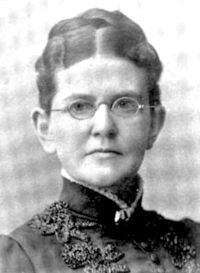 Mary J. Lincoln,
Carving and Serving
(1906)
Mary J. Lincoln,
Carving and Serving
(1906)
“ But in neat and careful serving it is essential to have a soup-ladle, a gravy or sauce ladle, a pair of tongs or shells for block sugar, a slender-tined silver fork for pickles, a plentiful supply of large and medium-sized spoons, a carving-rest, a crumb-scraper, and at least one broad silver knife and fork, which if occasion requires may do duty at several courses. LAST BUT NOT LEAST. In offering a second portion of anything do not remind one that he has already been helped. ”
Anna M. Cooley, Foods and Household Management…
“ Watch a good carver, and practice when you have a chance. A few simple directions can be given, but a demonstration is really necessary. First and foremost, have a sharp, strong knife, and a strong fork. The next essential is a platter large enough to hold the meat, without having it slip off. The fork must be firmly placed in the meat, and the meat held down. ”
F. F. Rockwell, Home Vegetable Gardening
“ In most soils it will do this work as well, if not better, than the spade and has the further good quality of being serviceable as a fork too, thus combining two tools in one. It should be more generally known and used. With the ordinary fork, used for handling manure and gathering up trash, weeds, etc., every gardener is familiar. The type with oval, slightly up-curved tines, five or six in number, and a D handle, is the most convenient and comfortable for garden use.For areas large enough for a horse to turn around in, use a plow. There are many good makes. ”
Price Collier, Germany and the Germans from an American Point of View
“ There is not a little use of the knife where the fork or spoon is called for; but this last I always look upon as a remnant of courage, of the virility remaining in the race from a not distant time when the knife served to clear the forest, to build the hut, to kill the deer, and to defend the family from the wolf; and the traditions of such a weapon still give it predominance over the more epicene fork, as a link with a stirring past. Mere daintiness in feeding is characteristic of the lapdog and other over-protected animals. ”
Anonymous, The boy's book of trades and the tools used in them (1866)
“ It is this process of fork grinding which has so often been made a subject for comment; the fork is ground dry upon a stone wheel, and the particles of steel and grit are constantly entering the lungs of the workmen, thereby ruining the health and shortening the duration of life. ”
 Seneca,
Canoe and Camp Cookery
Seneca,
Canoe and Camp Cookery
“ Cups or plates should be of tin or granite ware. The fork and knife have their sheaths of leather inside the box cover. The plates should nest in the frying pan, which should have no handle, and is fastened inside the chest cover by two buttons, so that it may be readily released. Next the knife and fork have a sheath for a pair of small blacksmith's pliers. ”
 Joshua Rose,
Modern Machine-Shop Practice, Volumes I and II
Joshua Rose,
Modern Machine-Shop Practice, Volumes I and II
“ Fig. 2381 represents a side and plan view of an ordinary form of fork-end rod, and the requirements are that the centre line a of the brass bores at the fork end shall be parallel with the centre line b of the bore at the butt end; that the side faces of all the brasses shall be parallel one to the other; that the side faces at the fork end shall be equidistant, or at the required distance, from the side faces at the butt end as denoted by c, d; that the bores of the brasses shall be at the proper distance apart to make the length of the rod come right ”
“ Should you, however, find yourself at a table where they have the old-fashioned steel forks, eat with your knife, as the others do, and do not let it be seen that you have any objection to doing so, nor let it be known that you ever do otherwise. He that advised us “to do in Rome as the Romans do” was a true gentleman.The fork is used in eating such vegetables as can be easily managed with it; those that cannot be [43] easily managed with it are eaten with a dessert-spoon—peas, stewed tomatoes, and succotash, for example, especially when they are served in small dishes. ”
