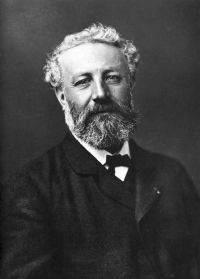
“ He, too, it was that invented the transformer, a more wonderful contrivance still, which takes the living force from the accumulator, and, on the simple pressure of a button, gives it back to space in whatever form may be desired, whether as heat, light, electricity, or mechanical force, after having first obtained from it the work required. From the day when these two instruments were contrived is to be dated the era of true progress. They have put into the hands of man a power that is almost infinite. ”
Transformer
Definition and stakes
A transformer is an electrical device that transfers energy through electromagnetic induction between circuits, allowing for voltage conversion and galvanic isolation. From Faraday’s groundbreaking discoveries to contemporary applications, writers such as Jules Verne foresaw its transformative potential, while engineers like Nikola Tesla and John Ambrose Fleming outlined its technical foundations.
Literature emphasizes its function in AC power systems, ranging from theoretical models to practical challenges such as leakage flux and performance. The development of the transformer highlights its essential role in electricity distribution, connecting theoretical advancements with real-world engineering.
Quotes about “transformer”
Garrett Putman Serviss, The Moon Metal
“ My transformer, with its concentrating mirror, acted as one pole, from which energy was transferred to the other pole, and that other pole immediately flung off atoms of its own substance in the direction of the transformer. But these atoms were stopped by the glass wall of the vacuum tube; and when I tried the experiment with the metal removed from the vacuum, and surrounded with air, it failed utterly. ”
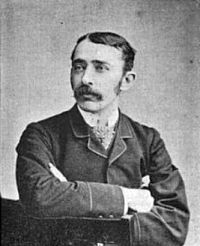 John Ambrose Fleming,
1911 Encyclopædia Britannica, Volume 27…
(1911)
John Ambrose Fleming,
1911 Encyclopædia Britannica, Volume 27…
(1911)
“ If a transformer is worked at a constant primary potential difference, the secondary terminal potential difference at no load or on open secondary circuit is greater than it is when the secondary is closed and the transformer giving its full output. ”
“ In a perfect transformer the efficiency would be 100 per cent. This signifies that the energy that is sent into the primary coil of the transformer exactly equals the energy in the secondary coil. The best transformers actually show efficiencies better than 97 per cent. The lost energy appears as heat in the transformer. "The transfer of great power in a large transformer from one circuit to another circuit entirely separate and distinct, without any motion or noise and almost without loss, is one of the most wonderful phenomena under the control of man." ”
N. Hawkins, Hawkins Electrical Guide v. 06…
“ The transformer is one of the essential factors in effecting the economical distribution of electric energy, and may be defined as an apparatus used for changing the voltage and current of an alternating circuit. A transformer consists essentially of:1. A primary winding; 2. A secondary winding; 3. An iron core. Basic Principles.—If a current be passed through a coil of wire encircling a bar of soft iron the iron will become a magnet; when the current is discontinued the bar loses its magnetization. ”
 Nikola Tesla,
My Inventions
(1919)
Nikola Tesla,
My Inventions
(1919)
“ The 'Tesla Transformer.' This apparatus is in the production of electrical vibrations as revolutionary as gunpowder was in warfare. Currents many times stronger than any ever generated in the usual ways, and sparks over one hundred feet long, have been produced by the inventor with an instrument of this kind.2. The 'Magnifying Transmitter.' This is Tesla's best invention, a peculiar transformer specially adapted to excite the Earth, which is in the transmission of electrical energy what the telescope is in astronomical observation. ”
 A. Frederick Collins,
The Radio Amateur's Hand Book
A. Frederick Collins,
The Radio Amateur's Hand Book
“ The Alternating Current Transformer.--An alternating current, or power, transformer is made on the same principle as a spark coil, that is, it has a soft iron core, a primary coil formed of a couple of layers of heavy wire, and a secondary coil wound up of a large number of turns of very fine wire. Unlike the spark coil, however, which has an open magnetic core and whose secondary coil is wound on the primary coil, the transformer has a closed magnetic core, with the primary coil wound on one of the legs of the core and the secondary wound on the other leg. ”
Elmer Ellsworth Burns, The Story of Great Inventions
“ A transformer is simply two coils of wire wound on an iron core. The simplest transformer is the form used by Faraday when he discovered electromagnetic induction. If instead of making and breaking a circuit that flows only in one direction as Faraday did, we cause an alternating current to flow through one of the coils, which we may call the primary, each time the current changes direction in the primary the magnetic field is reversed—that is, the end of the coil which was the north pole becomes the south pole. ”
Friedrich Uppenborn, History of the Transformer
“ Let us look back upon the inventions which were made in the domain of electric lighting by transformers from the time of Faraday’s discovery of induction up to the year 1880. There we see that three distinct characteristics were possessed by all the systems invented up to that year. These three characteristics lay in the construction, the ratio of transformation, and the method of employing the transformers. Single transformers, with two or more poles, were used. ”
Seabury Quinn, ../../ (1934)
“ Voilà, if he have physical properties, he can be destroyed by physical means.' "And so I set my trap. I procure a screen of copper, through which he could make entrance to the house—but I charged it with electricity—I increase the potential of the current with a step-up transformer, to make assurance doubly sure—and then I wait for him to try to enter, and electrocute himself." ”
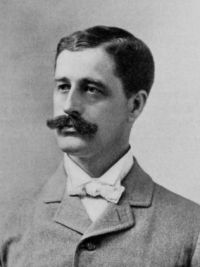 John F. Woodhull,
The Library of Work and Play: Electricity and Its Everyday Uses
John F. Woodhull,
The Library of Work and Play: Electricity and Its Everyday Uses
“ Indeed, electricity has always disported itself there in the lightning, jumping from cloud to mountain peak as I have seen it nowhere else on earth.The next time I saw the boys they had ambitious plans indeed. The penstock at the mill was to be repaired. The water-wheel was to drive an alternating current dynamo. The voltage of this current was to be stepped up by a transformer. It was to be transmitted to the cottage and there the e. m. f. was to be stepped down again by another transformer. My wife suggested that if it interfered with the simple life it would have to step down and out. ”
John Ambrose Fleming,
1911 Encyclopædia Britannica, Volume 27…
(1911)
“ In some cases transformers are designed to transform, not potential difference, but current in a constant ratio. The product of the root-mean-square (R.M.S.) , effective or virtual, values of the primary current, and the primary terminal potential difference, is called the apparent power or apparent watts given to the transformer. The true electrical power may be numerically equal to this product, but it is never greater, and is sometimes less. The ratio of the true power to the apparent power is called the power factor of the transformer. ”
John Ambrose Fleming,
1911 Encyclopædia Britannica, Volume 27…
(1911)
“ In the case of continuous current, the power factor is unity, and the effective value of the current or voltage is the true mean value. As the electrical measure of a power is always a product involving current and voltage, we may transform the character of the power by increasing or diminishing the current with a corresponding decrease or increase of the voltage. A transformer which raises voltage is generally called a step-up transformer, and one which lowers voltage a step-down transformer. ”
John Lord, Beacon Lights of History, Volume 14…
“ For here we have not only the dynamo, motors, and transformers that he gave freely to the world, not only the alternating-current transformer, and the system of transmission of power, but we even find that the principal consumers of the enormous electric power produced are employing it in carrying on some of the many processes in electro-chemistry, a science that he had done so much to advance. ”
N. Hawkins, Hawkins Electrical Guide v. 06…
“ The commercial transformer is not a perfect converter of energy, that is, the input, or watts applied to the primary circuit is always more than the output or watts delivered from the secondary winding. ”
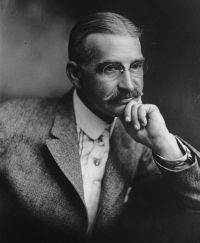 L. Frank Baum,
The art of decorating dry goods windows and interiors
(1900)
L. Frank Baum,
The art of decorating dry goods windows and interiors
(1900)
“ The “transformer” is a device for reducing the current from one potential or tension to another, and consists of a ring of many turns of insulated wire; the high tension wire is then wound around and through this ring several turns, and the low tension wire carrying the current into the building is wound around the opposite side of the ring in like manner. ”
Friedrich Uppenborn, History of the Transformer
“ In order to make possible the connection of transformers in parallel, the advantages of which it may be said Kennedy had augured, there was still much wanting. Above all there was wanting the idea of a transformer as meant at present, and an exact knowledge of its action. F. Geraldy has expressed himself very suitably upon this point in the introduction to his report upon the trials made with the system of Messrs. Gaulard and Gibbs. [7] “La distribution de l’électricité comporte la solution d’un grand nombre de problèmes. ”
John Ambrose Fleming,
1911 Encyclopædia Britannica, Volume 27…
(1911)
“ A rotatory or rotary transformer may consist of one machine, or of two separate machines, adapted for converting a single-phase alternating current into a poly phase current, or a poly phase current into a continuous current, or a continuous current into an alternating current. ”
John Ambrose Fleming,
1911 Encyclopædia Britannica, Volume 27…
(1911)
“ The designer of a transformer core has in view, first, economy in metal, so that there may be no waste fragments, and second, a mode of construction that facilitates the winding of the wire circuits. These consist of coils of cotton-covered copper wire which are wound on formers and baked after being well saturated with shellac varnish: The primary and secondary circuits are sometimes formed of separate bobbins which are sandwiched in between each other ”
Paul Severing, Marvels of Modern Science
“ That electric transmission of energy to long distances may be successfully carried out transformers are necessary for raising the pressure on the transmission line and for reducing it at the points of distribution. The transformer consists of a magnetic circuit of laminated iron or mild steel interlinked with two electric circuits, one, the primary, receiving electrical energy and the other the secondary, delivering it to the consumer. ”
Roy C. Burr, Something for Everyone (1916)
“ To prove there is no backward discharge at the transformer, leave a small gap at the terminals of the transformer secondary and an arc will be formed instead of a crashing spark. This simple device by directing all the energy to the close circuit, increases radiation but does not effect the wave length. ”
Various, Popular Science Monthly (1908)
“ A transformer by means of primary and secondary coils of wire of different diameters wound around a laminated iron core and with windings in a fixed ratio to each other may increase or diminish the voltage of a current according as an increase or a diminution of voltage may be necessary. ”
N. Hawkins, Hawkins Electrical Guide v. 06…
“ The larger transformers require greater pressure to overcome the resistance of longer air ducts.Fig. 1,964.—Forced draught or "air blast" transformer. As is indicated by the classification, this type of transformer is cooled by forcing a current of air through ducts, provided between the coils and between sectionalized portions of the core. The cold air is forced through the interior of the core containing the coils by a blower, the air passing vertically through the coils and out through the top. ”
Friedrich Uppenborn, History of the Transformer
“ At present the transformer serves principally to render possible the carrying of the current to a great distance economically. The electricians of those days were not so far advanced as to be able to run arc lamps independently of one another on the same circuit, and this they held to be quite impossible, whether the lamps were connected in parallel or series. ”
Paul Severing, Marvels of Modern Science
“ The transformer has made long distance the actual achievement that it is. It is this apparatus that brought the mountain to Mohammed. Without it high pressure would be impossible and it is on high pressure that success of long distance transmission depends. ”
A. E. Dolbear, The Machinery of the Universe: Mechanical Conceptions of Physical Phenomena
“ One may therefore say with certainty that every physical phenomenon is a change in the direction, or velocity, or character, of the energy present, and such change has been produced by matter acting as a transformer. ”
John Ambrose Fleming,
1911 Encyclopædia Britannica, Volume 27…
(1911)
“ The ratio between the power given out by a transformer and the power taken up by it is called its efficiency, and is best represented by a curve, of which the ordinate is the efficiency expressed as a percentage, and the corresponding abscissae represent the fractions of the full loadEfficiency. ”
Kirby Brooks, All That Goes Up
“ What about the transformer and plate? Well, I believe Professor Jordan is going to take a leave of absence and he and Jim are going to do some full time research on the device, whatever it is. They both think it has many possibilities. So do I, but I'm going to keep my feet on the ground. If they ever get there! ”
Louis Berman, The Glands Regulating Personality
“ On the other hand, it may be pointed out to our mechanists who believe in mechanism to the bitter end, that even if man can be described entirely as a mere transformer of energy, there is no reason why he cannot also be described as a transformer of energy plus someone who makes use of the transformer and of the energy transformed. ”
Alton D. Adams, Electric Transmission of Water Power
“ Where very high voltage must be developed or received with a three-phase system, the star or Y-connection of each group of three transformers has the advantage of a lower strain on the insulation of each transformer than that with the mesh or Δ-grouping. ”
Friedrich Uppenborn, History of the Transformer
“ There were, up till very lately, still many electricians who did not perceive the advantages of parallel connection, just for the simple reason that they were ignorant of the properties of the non-polar transformer, suiting the parallel system of connection for a rational system of distribution. ”
John Mills, Letters of a Radio-Engineer to His Son
“ It looks at first as if a transformer would always give a gain. If we mean a gain in energy it will not although we may use it, as we shall see in a minute, to permit a vacuum tube to work into an output circuit more efficiently than it could without the transformer. We cannot have any more energy 194 in the secondary circuit of a transformer than we give to the primary. ”
John Ambrose Fleming,
1911 Encyclopædia Britannica, Volume 27…
(1911)
“ In testing large transformers, when it is inconvenient to load up the secondary circuit to the full load, a close approximation to the power taken up at any assumed secondary load can be obtained by adding to the value of this secondary load, measured in watts, the iron core loss of the transformer, measured at no load, and the copper losses calculated from the measured copper resistances when the transformer is hot. ”
Nikola Tesla,
My Inventions
(1919)
“ In investigating the behaviour of high frequency currents I had satisfied myself that an electric field of sufficient intensity could be produced in a room to light up electrodeless vacuum tubes. Accordingly, a transformer was built to test the theory and the first trial proved a marvelous success. It is difficult to appreciate what those strange phenomena meant at that time. We crave for new sensations but soon become indifferent to them. The wonders of yesterday are today common occurrences. ”
John Ambrose Fleming,
1911 Encyclopædia Britannica, Volume 27…
(1911)
“ The rotatory transformer thus absorbs continuous current power and emits it in a periodic form; accordingly, there is a continual storage and emission of energy by the armature, and therefore its kinetic energy is periodically varying during the phase. The armature is also creating a back-electromotive force which acts at some instants against the voltage driving the current into the armature and at others is creating an electromotive force that assists the external impressed voltage in driving a current through the alternating current side. ”
Friedrich Uppenborn, History of the Transformer
“ There were no transformers in those days which, in the present sense of the word “transformer,” convert high electromotive force to low to suit the consumers. On the contrary the apparatus, which was then used in electric lighting plant, was such as converted low into high electromotive force, or such that the ratio was 1:1, or nearly so, according as it was determined by the connection in series of the primary coils, and the difference of potential at the consumption devices; for example, the induction coils of B. Ruhmkorff, Jablochkoff, and Gordon. ”
Friedrich Uppenborn, History of the Transformer
“ Besides this quality of non-polar transformers, their magnetic resistance is so low that the condition of very low internal resistance is easily fulfilled.The following conditions of a self-regulating and economical system of current distribution with transformers result, therefore, from the foregoing explanations:—1. The generator of current must give a great difference of potential as constant as possible at the terminals of the transformers, and also independent of the number fed. ”
Related terms
Authors who wrote about “transformer”
Roy C. BurrFriedrich UppenbornJohn Ambrose FlemingN. HawkinsAlton D. AdamsA. Frederick CollinsJohn Ambrose Fleming and Emile GarckeKirby BrooksJohn MillsNikola Tesla T. O'Conor SloaneVariousPaul SeveringJohn F. WoodhullSeabury QuinnElmer Ellsworth BurnsThomas D. CopeL. Frank BaumJohn LordGarrett Putman Serviss
John Ambrose FlemingN. HawkinsAlton D. AdamsA. Frederick CollinsJohn Ambrose Fleming and Emile GarckeKirby BrooksJohn MillsNikola TeslaT. O'Conor SloaneVariousPaul SeveringJohn F. WoodhullSeabury QuinnElmer Ellsworth BurnsThomas D. CopeL. Frank BaumJohn LordGarrett Putman Serviss