George Bernard Shaw,
John Bull's Other Island
(1904)
“ The fact is, there are only two qualities in the world: efficiency and inefficiency, and only two sorts of people: the efficient and the inefficient. ”
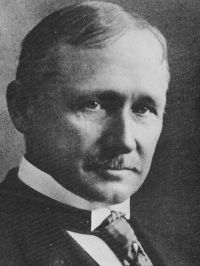
Efficiency, in statistical terms, measures the quality of estimators or methods, reflecting how quickly accurate results can be achieved using minimal data. It is defined by variance, with efficient estimators reaching the Cramér–Rao lower bound. Beyond statistics, authors like Frederick Winslow Taylor associated efficiency with scientific management, emphasizing systematic improvements in labor processes.
Ellen H. Richards linked it to public health and environmental considerations, while Thorstein Veblen analyzed its role in economic power. These viewpoints highlight efficiency as both a technical measure and a broader societal aspiration, influencing fields ranging from economics to industrial operations.
George Bernard Shaw,
John Bull's Other Island
(1904)
“ The fact is, there are only two qualities in the world: efficiency and inefficiency, and only two sorts of people: the efficient and the inefficient. ”
Anzia Yezierska,
Children of loneliness
(1923)
“ Efficiency begins at the employment office. Experts are hired for the one purpose, to find out how best to fit the worker to his work. It’s economy for the boss to make the [Pg 165] worker happy.” And then he talked a lot more on efficiency in educated language that was over my head.I didn’t know exactly what it meant—efficiency—but if it was to make the worker happy at his work, then that’s what I had been looking for since I came to America. ”
Scott Nearing,
The Next Step: A Plan for Economic World Federation
“ This is the purpose for which the unit exists. Efficiency is the product of the individual activity of the group members, and of the working effectiveness of the mechanism with which they accomplish their tasks. Thus both are essential to efficiency in production. ”
Willard E. Hotchkiss, Higher Education and Business Standards
“ Business standards must be discussed from the standpoint of efficiency, but efficiency needs to be interpreted. We may as well admit at the start that the efficiency ideal is not entirely in good repute at this moment.1 If I may import an expression from England, we have been somewhat "fed up" with efficiency during the recent past and the ration has been rather too much for our digestion. ”
Ellen H. Richards,
Euthenics, the science of controllable environment
“ America’s thought could be translated into the word efficiency. Yes, we might almost say she worships efficiency. If, then, efficiency is to be the goal, what are the means to develop it? Efficiency depends chiefly upon good health, and to maintain this we must first consider in the scheme of education the physical aids—food, air, water, clothing and shelter, exercise and rest—and with this goal in view must come also recreation, play or amusement, and beauty to develop the mental and the spiritual. ”
Thorstein Veblen,
The Place of Science in Modern Civilisation…
“ The efficiency of the control exercised by the master-workman, engineer, superintendent, or whatever term may be used to designate the technological expert who controls and correlates the productive processes,—this workmanlike efficiency determines how far the given material equipment is effectually to be rated as "capital goods." ”
Frank A. Fetter,
The Principles of Economics, with Applications to Practical Problems
“ Subjective and objective factors of efficiency1. The efficiency of labor, in its broadest sense, is its ability to render services or produce things that minister to welfare. The efficiency of labor is a resultant of many influences. ”
Franklin Henry Giddings,
Popular Science Monthly
(1909)
“ The struggle for abundance begets the struggle for efficiency. Ideas and standards of efficiency appear. The efficient find each other out. They like each other and each other's ways. They dislike the inefficient, and begin in all possible ways to make life unpleasant for them. ”
Mihai Nadin, The Civilization of Illiteracy
“ Ours is a world of efficiency. Although more obvious on the computer screen, and on the command buttons and touch-sensitive levers of the machines we rely quite heavily upon, efficiency expectations met in business and financial life insinuate themselves into the intimacy of our private lives as well. As a result of efficiency expectations, we have changed almost everything we inherited in our homes-kitchen, study, or bathroom-and redefined our respective social or family roles. We do almost everything others used to do for us. ”
Business Administration: Theory…
“ Ah, that enchanting word, S-U-C-C-E-S-S. It does not require a magic key to unlock the door to business efficiency. There is nothing mystic, nothing mysterious in the applied method of the really resourceful men in this day of great successes, of marvelous achievements in business enterprise. The sum total is contained in two words, words that electrify, nevertheless. ”
Business Administration: Theory…
“ Managers of industrial enterprises will undoubtedly agree that there are few qualities which are more to be desired in equipment, methods and men than that of efficiency. From an extensive study of this subject in various parts of the country, together with interviews and correspondence with several hundred concerns, the writer has become convinced that there is a general lack of definite comprehension of what efficiency is, whence it springs, how it may be measured and developed and the results which its cultivation will produce. ”
Lillian Moller Gilbreth,
The Psychology of Management
“ Measurement of Individual Efficiency Will Be Endorsed by All. — 2. The worker will, ultimately, realize that it is for the good of all, as well as for himself, that individual efficiency be measured and rewarded.It has been advanced as an argument against measurement that it discriminates against the "weaker brother," who should have a right to obtain the same pay as the stronger, for the reason that he has equal needs for this pay to maintain life and for the support of his family. ”
Business Administration: Theory…
“ Our perception of efficiency, therefore, is correct only in proportion to the precision of the standard, which must be accurately developed from data which are not only exact, but complete. A machinist, believed to be operating at high efficiency, was observed while turning a shaft. ”
Winifred Louise Taylor, The Man Behind the Bars
“ The grade of "industrial efficiency" recently introduced serves as a further incentive to skill and industry and will secure special recommendation for efficiency when the men are free to take their own places in the world. ”
Thorstein Veblen,
The Place of Science in Modern Civilisation…
“ So long as industrial efficiency is chiefly a matter of the handicraftsman's skill, dexterity, and diligence, the attention of men in looking to the industrial process is met by the figure of the workman, as the chief and characteristic factor; and thereby it comes to run on the personal element in industry. ”
Scott Nearing,
Popular Science Monthly
(1912)
“ Efficiency is an essential item in the success of any business—not the efficiency of any one man, but of the entire working group. Although efficiency is so intimately connected with success, on the one hand, it is no less closely related to standards of living, on the other. ”
Otto Jespersen,
Language: Its Nature, Development and Origin
“ It will be noticed that my formula contains two requirements: it demands a maximum of efficiency and a minimum of effort. Efficiency means expressiveness, and effort means bodily and mental labour, and thus the formula is simply one of modern energetics. But unfortunately we are in possession of no method by which to measure either expressiveness or effort exactly, and in cases of conflict it may be difficult to decide to which of the two sides we are to attach the greater importance, how great a surplus of efficiency is required to counterbalance a surplus of exertion, or inversely. ”
Martha Foote Crow,
The American Country Girl
“ In order to accomplish all this in, say, the business and work of a factory, there must be an efficiency engineer, who shall spend days and weeks and months in finding out what the right order of motions is, what the best arrangement of the tools and materials shall be, what elimination of unnecessary acts and things can be made in order that every possible waste of energy may be pared off and the path to the end may be absolutely, sternly direct. ”
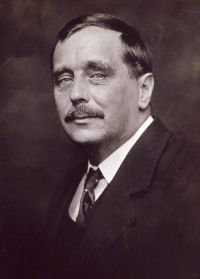
H. G. Wells,
An Englishman Looks at the World
“ One hears nowadays a vast amount of chatter about efficiency—that magic word—and social organisation, and there is no doubt a huge expenditure of energy upon these things and a widespread desire to rush about and make showy and startling changes. ”
Lillian Moller Gilbreth,
The Psychology of Management
“ This question, like the one that precedes it, is answered by Scientific Management. It has demonstrated that the emphasis in successful management lies on the man, not on the work; that efficiency is best secured by placing the emphasis on the man, and modifying the equipment, materials and methods to make the most of the man. It has, further, recognized that the man's mind is a controlling factor in his efficiency, and has, by teaching, enabled the man to make the most of his powers. ”
Walter Kubilius, Stirring Science Stories (1942-03)
“ Always be careful," the booming voice in the factory rang out. "Do not make mistakes. Efficiency counts above all else. Efficiency! Work carefully. Work carefully. Work carefully. Work carefully and enjoy your work. Enjoy your work. Enjoy your work because it is your work. ”
John Stuart Mill,
Principles of Political Economy
(1871)
“ It is sufficient here to remark, that the efficiency of industry may be expected to be great, in proportion as the fruits of industry are insured to the person exerting it: and that all social arrangements are conducive to useful exertion, according as they provide that the reward of every one for his labour shall be proportioned as much as possible to the benefit which it produces. ”
Walter Dill Scott,
Increasing Human Efficiency in Business
“ By working out and establishing a standard method and standard time for various ``repeat'' operations a workman is engaged in, it encourages—and even enforces—the formation of new efficiency habits. The bonus paid for the accomplishment of the task in the specified time supplies an immediate and powerful motive to the effort necessary to master the ``right way'' of doing things. ”
Martha Foote Crow,
The American Country Girl
“ Therefore it is for her to see what scientific management means to all these other institutions and to apply the lesson to her own realm, and make that factory of hers, that workshop, regiment, and studio, into the most efficient place upon earth!The great movement in the interest of efficiency has its origin in the desire to get just as much result as possible out of the labor of the workers. Their strength must be conserved, not because of any philanthropic feeling for the man, but because that strength is needed for further use, in order that a greater output of the product may be gained. ”
Thorstein Veblen,
The instinct of workmanship, and the state of industrial arts
(1914)
“ The relation of cause and effect, as commonly conceived by the vulgar and as commonly employed by the scientist, is a putative relation between phenomena which can not be said to stand in any observed relation of efficiency to one another. Efficiency, as understood in this connection, is not a fact of observation, but of imputation; and efficiency, performance of work, is the substance of the causal relation as that concept is universally employed in modern science. ”
Scott Nearing,
The Next Step: A Plan for Economic World Federation
“ The Essentials for Maximum ReturnsThe efficiency of the economic unit—the mine, the factory, the railroad division—depends upon the attitude of the individual human beings of which the unit is composed. Just as the entire economic system is made up of an aggregate of functioning units, so each unit is made up of functioning individuals. ”
Walter Dill Scott,
Increasing Human Efficiency in Business
“ The rate at which skill is acquired has been the subject of many careful studies. The results have been charted and reduced to curves, variously spoken of as ``efficiency curves,'' ``practice curves,'' ``learning curves,'' according to the nature of the task or test. ”
Geo. T. Fairchild, Rural Wealth and Welfare: Economic Principles Illustrated and Applied in Farm Life
“ Increased efficiency of capital.—The efficiency of capital in production is greatly increased by minute division of labor. The shop room required for each man is reduced to the minimum space for himself and his material. His tools, while the most perfect possible, are the fewest possible. The machinery and motive power are used to their utmost capacity constantly, and the economy of larger engines and machines is well known. ”
Walter Dill Scott,
Increasing Human Efficiency in Business
“ They depict the rate at which the beginner increases his efficiency. In every case we discover very greatfluctuations. On one day or at one moment there is a sudden phenomenal improvement. The next day or even the next moment the increase may be lost and a return made to a lower stage of efficiency.
”
Emory S. Bogardus, A history of social thought (1922)
“ Efficiency is a term which is the product of the mechanical era, which originated in the business world, and which is now being applied to all phases of social organization.XXVI-46 Its aim is perfection in social mechanics. Social efficiency includes not only social engineering but social knowledge, social philosophy, social ethics, and social religion. Evidences of social inefficiency are common; for example, the failure to use and apply the social knowledge that467 we have, and the loss of energy through an over-emphasis on competition. ”
Thorstein Veblen,
The instinct of workmanship, and the state of industrial arts
(1914)
“ Habituation to bargaining and to the competitive principles of business necessarily brings it about that pecuniary standards of efficiency invade (contaminate) 349 the sense of workmanship; so that work, workmen, equipment and products come to be rated on a scale of money values, which has only a circuitous and often only a putative relation to their workmanlike efficiency or their serviceability. ”
Lillian Moller Gilbreth,
The Psychology of Management
“ Records of individual efficiency are comparatively easy to make when output is separated. But even when work must be done by gangs or teams of men, there is provision made in Scientific Management for recording this gang work in such a way that either the output or the efficiency, or both, of each man shows up separately. ”
Business Administration: Theory…
“ Moreover, the results of efficiency methods, within the writer’s knowledge, are sufficient to convince him that their general adoption would so increase the purchasing power of the employe, by increasing his wages and decreasing the cost production, as to have a markedly beneficial and steadying effect upon the business of the country. ”
James Slough Zerbe, Practical Mechanics for Boys
“ It is constantly growing in prominence, and calls for the exercise of the skill of the engineer and the ingenuity of the mechanic. Efficiency and economy are the two great watchwords, and this is what the world is striving for. Success will come to him who can contribute to it in the smallest degree. ”
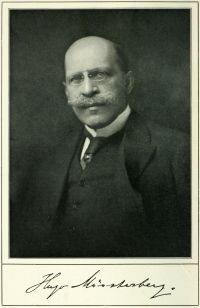
Hugo Münsterberg,
Psychology and Industrial Efficiency
“ The problem of attention, indeed, seems to stand quite in the centre of the field of industrial efficiency. This conviction has grown upon me in my observation of industrial life. The peculiar kind of attention decides more than any mental trait for which economic activity the individual is adapted. ”
Walter Dill Scott,
Increasing Human Efficiency in Business
“ CHAPTER X THE RATE OF IMPROVEMENT IN EFFICIENCY NO novice develops suddenly into an expert. Nevertheless the progress made by beginners is often astounding. The executive with experience is not deceived by the showing made by new men. He has learned to accept rapid initial progress, but he does not assume that this initial rate of increase will be sustained. ”
Scott Nearing,
Popular Science Monthly
(1912)
“ EFFICIENCY, when applied to personal capacity, signifies a maximum of return with a minimum of outlay; hence one man is more efficient than another if, with a given expenditure of energy, time, raw material or capital, he can secure a larger, though equally good, product. The term efficiency is thus purely relative, since there is no known limit to human possibilities. ”
Thorstein Veblen,
The Theory of Business Enterprise
(1904)
“ Such a habit of mind conduces to industrial efficiency, and the wide prevalence of such a habit is indispensable to a high degree of industrial efficiency under modern conditions. This habit of mind prevails most widely and with least faltering in those communities that have achieved great things in the machine industry, being both a cause and an effect of the machine process. ”
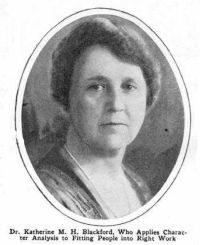
Katherine M. H. Blackford,
Analyzing Character
“ The philosophy of efficiency is for an industrial plant—for any enterprise, activity, or undertaking—what a network of good roads is for automobiles. Undoubtedly, even on poor roads, automobiles may make some progress, but the worse the road, the more elementary must be the means of locomotion. ”
Frederick Winslow Taylor,
The Principles of Scientific Management
(1913)
“ This means increase in prosperity and diminution in poverty, not only for their men but for the whole community immediately around them. As one of the elements incident to this great gain in output, each workman has been systematically trained to his highest state of efficiency, and has been taught to do a higher class of work than he was able to do under the old types of management ”
Thorstein Veblen,
The instinct of workmanship, and the state of industrial arts
(1914)
“ It is then the duty of these efficiency engineers to present the results so obtained, for the conviction and guidance of the businessmen in charge, who thereupon, if their business training has left them enough of a sense of workmanship, will give permissive instructions to the expert workmen in direct charge of the industrial processes to put these statistically indicated changes into effect. ”
Calls for administrative efficiency are frequently co-opted as a political strategy to inflict chaos, compromise the civil service, and strategically dismantle public programs through procedural sabotage rather than democratic debate.
The contemporary debate over flexible work arrangements is defined by a deep philosophical conflict: are policies favoring workers strategic inputs for efficiency or are they rights essential for dignity and self-determination? This historical schism shapes every negotiation.