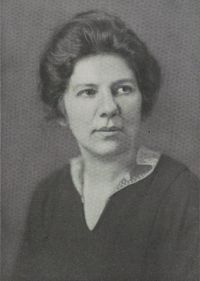
Anzia Yezierska

Anzia Yezierska

Summary

Portrait of Anzia Yezierska Anzia Yezierska Children of loneliness (1923)

I had expected to work in America, but work at the thing I loved—work with my mind, my heart, prepared for my work by education. I had dreamed of free schools, free colleges, where I could learn to give out my innermost thoughts and feelings to the world. But no sooner did I come off the ship than hunger drove me to the sweatshop, to become a “hand”—not a brain—not a soul—not a spirit—but just a “hand”—cramped, deadened into a part of a machine—a hand fit only to grasp, not to give.
Time came when I was able to earn my bread and rent.
Source: Gutenberg

Portrait of Anzia Yezierska Anzia Yezierska Children of loneliness (1923)

My eyes will always turn back with loneliness and longing for the old faces and old scenes that I loved more than my life. But though it tears my heart out of my body to go on, I must go on.
There’s no going back to the Old World for anyone who has breathed the invigorating air of America. I return to America with the new realization that in no other country would a nobody from nowhere—one of the millions of lonely immigrants that pour through Ellis Island—a dumb thing with nothing but hunger and desire, get the chance to become articulate that America has given me.
Source: Gutenberg

Portrait of Anzia Yezierska Anzia Yezierska Children of loneliness (1923)

But I saw I had to fight for my chance to give what I had to give, with the same life-and-death earnestness with which a man fights for his bread.
What had I with my empty hands and my hungry heart to give to America? I had my hunger, my homelessness, my dumbness, my blind searchings and gropings for what I knew not. I had to give to America my aching ignorance, my burning desire for knowledge. I had to give to America the dirt and the ugliness of my black life of poverty and my all-consuming passion for beauty.
Source: Gutenberg

Get perspective with Kwize: daily news enlightened by great literature