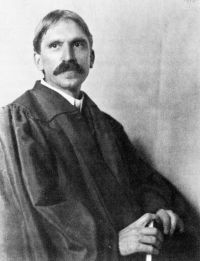
Emory S. Bogardus

Biographical details

Emory S. Bogardus A history of social thought (1922)

This process is the essence of invention, the highest and most useful form of labor. Without wings, valuable weapons of offense and defense, claws for digging, man has had but one line of advance open to him, namely, invention, whereby he could overcome his limitations and master nature.
Ward overlooked what Veblen has called the instinct of workmanship. Man has a desire to do, to achieve, to be active—only so can he escape the terrors of ennui. He secures illimitable enjoyment from seeing the crude materials of nature change under the manipulations of his hand and mind into works of art.
Source: Gutenberg

Emory S. Bogardus A history of social thought (1922)

Irrespective of religious needs, man has endeavored to discover proper relations to his universe. He has philosophized. He has tried to reduce to terms of thought this baffling, intangible, universal environment. He has searched for a specific ground for explaining the universe. He has sought unity in change and monism in multiplicity. He has proclaimed that change itself is Lord of the universe, or perhaps he has found solace in a creative evolution. At any rate, he has sought ultimate meanings in as unbiased an interpretation of the universe as is humanly possible.
Source: Gutenberg

Get perspective with Kwize: daily news enlightened by great literature