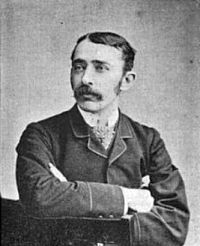
 John Ambrose Fleming,
1911 Encyclopædia Britannica, Volume 27…
(1911)
John Ambrose Fleming,
1911 Encyclopædia Britannica, Volume 27…
(1911)
“ Experiment has shown< [2] that if a transformer is tested for efficiency of various alternators having electromotive force curves of different forms, the efficiency values found at the same secondary load are not identical, those being highest which belong to the alternator with the most peaked curve of electromotive force, that is, the curve having the largest form factor. This is a consequence of the fact that the hysteresis loss in the iron depends upon the manner in which the magnetization (or what here comes to the same thing, the flux-density in the core) is allowed to change. ”
