Summary

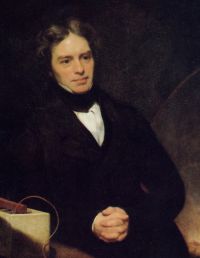
Portrait of Michael Faraday Michael Faraday Experimental Researches in Electricity…

The theory of definite electrolytical or electro-chemical action appears to me to touch immediately upon the absolute quantity of electricity or electric power belonging to different bodies. It is impossible, perhaps, to speak on this point without committing oneself beyond what present facts will sustain; and yet it is equally impossible, and perhaps would be impolitic, not to reason upon the subject. Although we know nothing of what an atom is, yet we cannot resist forming some idea of a small particle, which represents it to the mind
Source: Gutenberg

Portrait of Michael Faraday Michael Faraday Experimental Researches in Electricity…

We have but very imperfect notions of the real and intimate conditions of the particles of a body existing in the solid, the liquid, and the gaseous state; but when we speak of the gaseous state as being due to the mutual repulsions of the particles or of their atmospheres, although we may err in imagining each particle to be a little nucleus to an atmosphere of heat, or electricity, or any other agent, we are still not likely to be in error in considering the elasticity as dependent on mutuality of action.
Source: Gutenberg

Portrait of Michael Faraday Michael Faraday Experimental Researches in Electricity…

The power, instead of being like that of gravity, which causes particles to act on each other through straight lines, whatever other particles may be between them, is more analogous to that of a series of magnetic needles, or to the condition of the particles considered as forming the whole of a straight or a curved magnet. So that in whatever way I view it, and with great suspicion of the influence of favourite notions over myself, I cannot perceive how the ordinary theory applied to explain induction can be a correct representation of that great natural principle of electrical action.
Source: Gutenberg

Get perspective with Kwize: daily news enlightened by great literature