Summary

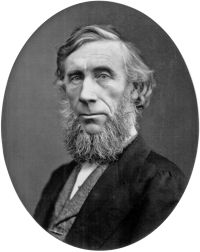
Portrait of John Tyndall John Tyndall Faraday as a Discoverer

The objects of scientific thought being the passionless laws and phenomena of external nature, one might suppose that their investigation and discussion would be completely withdrawn from the region of the feelings, and pursued by the cold dry light of the intellect alone. This, however, is not always the case. Man carries his heart with him into all his works. You cannot separate the moral and emotional from the intellectual; and thus it is that the discussion of a point of science may rise to the heat of a battle-field.
Source: Gutenberg

Portrait of John Tyndall John Tyndall Faraday as a Discoverer

He loved to quote Newton upon this point; over and over again he introduces his memorable words, 'That gravity should be innate, inherent, and essential to matter, so that one body may act upon another at a distance through a vacuum and without the mediation of anything else, by and through which this action and force may be conveyed from one to another, is to me so great an absurdity, that I believe no man who has in philosophical matters a competent faculty of thinking, can ever fall into it.
Source: Gutenberg

Portrait of John Tyndall John Tyndall Faraday as a Discoverer

Let us for the sake of simplicity confine our attention to the case of attraction. The attraction exerted between the earth and a body at a distance from the earth's surface is a source of working-power; because the body can be moved by the attraction, and in falling to the earth can perform work. When it rests upon the earth's surface it is not a source of power or energy, because it can fall no further. But though it has ceased to be a source of energy, the attraction of gravity still acts as a force, which holds the earth and weight together.
Source: Gutenberg

Get perspective with Kwize: daily news enlightened by great literature