Summary

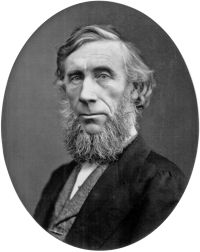
Portrait of John Tyndall John Tyndall Dictionary of National Biography… (1889)

Faraday's experiments and reasonings on electrolysis compelled him to look into the very heart of his decomposing liquids and to bring their ultimate molecules within his range of vision. He had no doubt that the current was propagated from particle to particle of the electrolyte, and he became more end more impressed with the conviction that ordinary electric induction was also transmitted and sustained by the action of contiguous particles. The idea of action at a distance obviously perplexed and bewildered him, and it may be added that in our own day this idea is retreating more and more
Source: Wikisource

Portrait of John Tyndall John Tyndall Dictionary of National Biography… (1889)

But there is transmission, hence space is a conductor. Thus he hampers the atomic theory. 'The reasoning ends in a subversion of that theory altogether; for, if space be an insulator, it cannot exist in conducting bodies, and if it be a conductor, it cannot exist in insulating bodies. Any ground of reasoning,' he adds, abandoning his usual temperate caution, 'which tends to such conclusions as these, must in itself be false.' Like Boscovich, Faraday abolished the atom, and put a 'centre of force' in its place.
Source: Wikisource

Portrait of John Tyndall John Tyndall Dictionary of National Biography… (1889)

To this power of propagation he gave the name 'specific inductive capacity.' He then glanced at conduction in its relation to induction, and generalised thus: 'Can we not, by a gradual chain of association, carry up the discharge from its occurrence in air through spermaceti and water to solutions, and then on to chlorides, oxides, and metals, without any essential change in its character?' The action of the particles of the best conductor differs, according to Faraday, only in degree from that of the particles of the insulator.
Source: Wikisource

Get perspective with Kwize: daily news enlightened by great literature