Summary

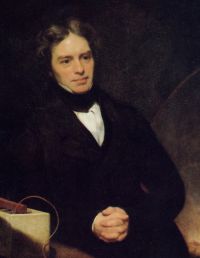
Portrait of Michael Faraday Michael Faraday On the various forces of nature and their relations to each other

Now, how curiously our ideas expand by watching these conditions of the attraction of cohesion!—how many new phenomena it gives us beyond those of the attraction of gravitation! See how it gives us great strength. The things we deal with in building up the structures on the earth are of strength (we use iron, stone, and other things of great strength) ; and only think that all those structures you have about you—think of the “Great Eastern,” if you please, which is of such size and power as to be almost more than man can manage—are the result of this power of cohesion and attraction.
Source: Gutenberg

Portrait of Michael Faraday Michael Faraday On the various forces of nature and their relations to each other (1894)

Even when we can see the stars clearly on a bright night, it is not a pure atmosphere. The light of a light-house, more than any other, is liable to be dimmed by vapours and fogs; and where we most want this great power, is not in the finest condition of the atmosphere, but when the mariner is in danger—when the sleet and rain are falling, and the fogs arise, and the winds are blowing, and he is nearing coasts where the water is shallow, and abounds with rocks,—then is his time of danger, when he most wants this light.
Source: Wikisource

Portrait of Michael Faraday Michael Faraday On the various forces of nature and their relations to each other

I am going to shew you how, by means of a little steam, I can completely obscure this glorious sun, this electric light which you see. The cloud now obscuring the light on the screen is only such a cloud as you see when sitting in a train on a fine summer’s day. You may observe that the vapour passing out of the funnel casts as deep a shadow on the ground as the black funnel; the very sun itself is extinguished by the steam from the funnel, so that it cannot give any light; and the sun itself, if set in the light-house, would not be able to penetrate such a vapour.
Source: Gutenberg

Get perspective with Kwize: daily news enlightened by great literature