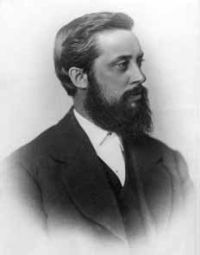
William Arnold Anthony

William Arnold Anthony

Summary

Portrait of William Arnold Anthony William Arnold Anthony Elementary Text-book of Physics (1897)

When a natural phenomenon arrests our attention, we call the result an observation. Simple observations of natural phenomena only in rare instances can lead to such complete knowledge as will suffice for a full understanding of them. An observation is the more complete, the more fully we apprehend the attending circumstances. We are generally not certain that all the circumstances which we note are conditions on which the phenomenon, in a given case, depends. In such cases we modify or suppress one of the circumstances, and observe the effect on the phenomenon.
Source: Wikisource

Portrait of William Arnold Anthony William Arnold Anthony Elementary Text-book of Physics (1897)

We are almost constantly obliged, in physical science, to measure the quantities with which we deal. We measure a quantity when we compare it with some standard of the same kind. A simple number expresses the result of the comparison.
If we adopt arbitrary units of length, time, and mass (or quantity of matter) , we can express the measure of all other quantities in terms of these so-called fundamental units. A unit of any other quantity, thus expressed, is called a derived unit.
Source: Wikisource

Portrait of William Arnold Anthony William Arnold Anthony Elementary Text-book of Physics (1897)

We have already seen that a current in an electrolyte may be considered as the transfer of charges on the moving ions. If the ions in solution be dissociated from each other, and if the effect of the electromotive force in the circuit be merely directive, it is plain that the quantity of current transferred will depend on the relative velocity with which the ions move past each other in the solution as well as on their number. Starting with this conception, we will show that the conductivity of an electrolyte is proportional to the sum of the velocities of its ions.
Source: Wikisource

Get perspective with Kwize: daily news enlightened by great literature