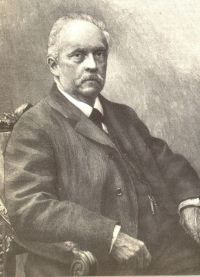
Hermann von Helmholtz

Hermann von Helmholtz

Summary

Portrait of Hermann von Helmholtz Hermann von Helmholtz,  Popular Science Monthly (1881)

“ If we conclude from the facts that every unit of affinity of every atom is charged always with one equivalent, either of positive or of negative electricity, they can form compounds, being electrically neutral, only if every unit charged positively unites under the influence of a mighty electric attraction with another unit charged negatively. You see that this ought to produce compounds in which every unit of affinity of every atom is connected with one and only with one other unit of another atom. ”
Source: Wikisource

Portrait of Hermann von Helmholtz Hermann von Helmholtz,  Popular Science Monthly (1881)

“ If any chemical force existed besides that of the electrical charges, which could bind all the pairs of opposite ions together, and require any amount of work to be vanquished, an inferior limit to the electro-motive forces ought to exist, which forces are able to attract the atoms to the electrodes and to charge these as condensers. No phenomenon indicating such a limit has as yet been discovered, and we must conclude, therefore, that no other force resists the motions of the ions through the interior of the liquid than the mutual attractions of their electric charges. ”
Source: Wikisource

Portrait of Hermann von Helmholtz Hermann von Helmholtz,  Popular Science Monthly (1881)

“ Now, the most startling result, perhaps, of Faraday's law is this: If we accept the hypothesis that the elementary substances are composed of atoms, we can not avoid concluding that electricity also, positive as well as negative, is divided into definite elementary portions, which behave like atoms of electricity. As long as it moves about on the electrolytic liquid, each atom remains united with its electric equivalent or equivalents. ”
Source: Wikisource

Get perspective with Kwize: daily news enlightened by great literature