Summary

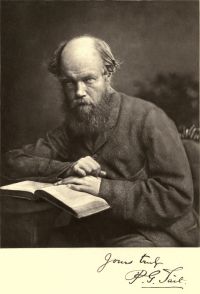
Portrait of Peter Guthrie Tait Peter Guthrie Tait 1911 Encyclopædia Britannica, Volume 17… (1911)

In private life Clerk Maxwell was one of the most lovable of men, a sincere and unostentatious Christian. Though perfectly free from any trace of envy or ill-will, he yet showed on fit occasion his contempt for that pseudo-science which seeks for the applause of the ignorant by professing to reduce the whole system of the universe to a fortuitous sequence of uncaused events.
Source: Wikisource

Portrait of Peter Guthrie Tait Peter Guthrie Tait 1911 Encyclopædia Britannica, Volume 17… (1911)

Availing himself of the admirable generalized co-ordinate system of Lagrange, Maxwell showed how to reduce all electric and magnetic phenomena to stresses and motions of a material medium, and, as one preliminary, but excessively severe, test of the truth of his theory, he pointed out that (if the electromagnetic medium be that which is required for the explanation of the phenomena of light) the velocity of light in vacuo should be numerically the same as the ratio of the electromagnetic and electrostatic units.
Source: Wikisource

Portrait of Peter Guthrie Tait Peter Guthrie Tait 1911 Encyclopædia Britannica, Volume 17… (1911)

In his eighteenth year, while still a student in Edinburgh, he contributed two valuable papers to the Transactions of the same society—one of which, “On the Equilibrium of Elastic Solids,” is remarkable, not only on account of its intrinsic power and the youth of its author, but also because in it he laid the foundation of one of the most singular discoveries of his later life, the temporary double refraction produced in viscous liquids by shearing stress.
Source: Wikisource

Get perspective with Kwize: daily news enlightened by great literature