Summary

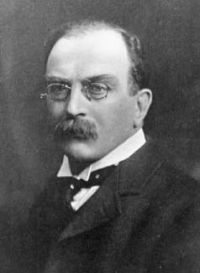
Portrait of Joseph Larmor Joseph Larmor Dictionary of National Biography… (1912)

Both were impelled by the keenest interest in the advance of scientific discovery, but their endowments were in some respects complementary. Stokes remained a student throughout has life, closely pondering over mathematical questions and the causes of natural phenomena, perhaps over-cautious in drawing conclusions and in publication of his work, remarkable for his silence and abstraction even in crowded assemblies, but an excellent man of affairs, inspiring universal confidence for directness and impartiality in such administration as came to him.
Source: Wikisource

Portrait of Joseph Larmor Joseph Larmor Dictionary of National Biography… (1912)

His earlier scientific work, with that of Helmholtz and Lord Kelvin, may be said to mark the breaking away of physical science from the à priori method depending on laws of attraction, which was inherited from the astronomers ; for this there was substituted a combination of the powerful analysis by partial differentials, already cultivated by Laplace and Fourier, with close attention to the improvement of physical ideas and modes of expression of natural phenomena.
Source: Wikisource

Portrait of Joseph Larmor Joseph Larmor Dictionary of National Biography… (1912)

In 1851 he had been elected F.R.S., and next year was awarded the Rumford medal for his discovery of the nature of fluorescence. In 1854 he became secretary of the Royal Society, and the thirty-one years of his tenure of this office (1854-5) were devoted largely to the advancement of science in England and the improvement of the publications of the Royal Society. There were few of the memoirs on physical science that passed to press through his hands that did not include valuable extensions and improvements arising from his suggestions.
Source: Wikisource

Get perspective with Kwize: daily news enlightened by great literature