Summary

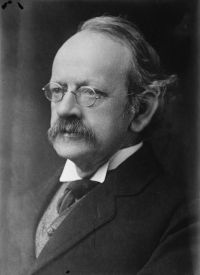
Portrait of Joseph John Thomson Joseph John Thomson Rays of Positive Electricity and Their Application to Chemical Analyses… (1913)

We may suppose that the process by which the retrograde rays are produced is somewhat as follows : neutral atoms or molecules acquire a negative charge when they are just in front of the cathode, they are then repelled from the cathode and driven through the dark space, acquiring under the electric field in the discharge tube a velocity of the same order as that acquired by the positively electrified particles of the positive rays during their approach to the cathode.
Source: Wikisource

Portrait of Joseph John Thomson Joseph John Thomson Rays of Positive Electricity and Their Application to Chemical Analyses… (1913)

A simple method of demonstrating the existence of retrograde rays and also of the places at which the positive rays originate Is founded on the difference between the phosphorescence of lithium chloride under cathode and positive rays. When lithium chloride is struck by cathode rays, the phosphorescence is a steely blue giving a continuous spectrum. When struck by rapidly moving positively electrified particles the phosphorescence is a rich deep red, and the red lithium line is very bright in the spectrum.
Source: Wikisource

Portrait of Joseph John Thomson Joseph John Thomson Rays of Positive Electricity and Their Application to Chemical Analyses… (1913)

Using a tube through A about .5 mm. in diameter I obtained a photograph of the retrograde rays which gave the following results:—
There are in the retrograde rays positively electrified atoms and molecules of hydrogen and positively electrified atoms of oxygen: there are also negatively electrified atoms of hydrogen and oxygen, and with these rays the intensity of the lines corresponding to the negatively electrified particles is greater than that of the positively electrified ones; with the ordinary positive rays the positive lines are much stronger than the negative.
Source: Wikisource

Get perspective with Kwize: daily news enlightened by great literature