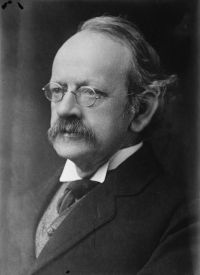
 Joseph John Thomson,
Rays of Positive Electricity and Their Application to Chemical Analyses…
(1913)
Joseph John Thomson,
Rays of Positive Electricity and Their Application to Chemical Analyses…
(1913)
“ The most natural explanation of these rays is that the hot salts from which they originate act like fused electrolytes, and that the current through them into the discharge tube is carried by the ions into which the salts dissociate, the positive ion, which is a charged atom of the metallic constituent of the salt, following the current will come to the surface of the anode, will get detached from it, and under the influence of the strong electric field which exists in the gas close to the anode will acquire the high velocity characteristic of the anode rays. ”
