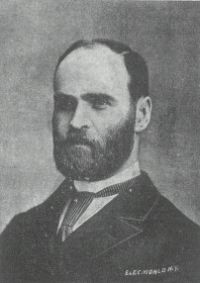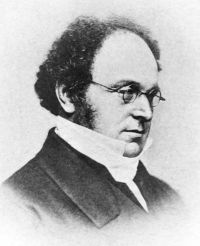
Augustus De Morgan

Biographical details

Portrait of Augustus De Morgan Augustus De Morgan A Budget of Paradoxes, Volume I

Since Virgil was afterwards a Bishop and a Saint, we may fairly conclude that he died in the full flower of his orthodox reputation. It has been supposed—and it seems probable—that Virgil maintained that the earth is peopled all the way round, so that under some spots there are antipodes; that his contemporaries, with very dim ideas about the roundness of the earth, and most of them with none at all, interpreted him as putting another earth under ours—turned the other way, probably, like the second piece of bread-and-butter in a sandwich, with a sun and moon of its own.
Source: Gutenberg

Portrait of Augustus De Morgan Augustus De Morgan A Budget of Paradoxes — 1860-1862 (1872)

How then comes the history of astronomy among the paradoxes? Simply because the author, so admirably when writing about what he knew, did not know what he did not know, and blundered like a circle-squarer. And why should the faults of so good a writer be recorded in such a list as the present? For three reasons: First, and foremost, because if the exposure be not made by some one, the errors will gradually ooze out, and the work will get the character of inaccurate. Nothing hurts a book of which few can fathom the depths so much as a plain blunder or two on the surface.
Source: Wikisource

Portrait of Augustus De Morgan Augustus De Morgan A Budget of Paradoxes, Volume II

Let every allowance be made for them: but their unholy fire must be trodden out; so long as a spark is left, nothing but fuel is wanted to make a blaze. If this cannot be done, let the flame be confined to theology, though even there it burns with diminished vigor: and let charity, candor, sense, and ridicule, be ready to play upon it whenever there is any chance of its extending to literature and science.
"What would be the consequence if this test-signing absurdity were to grow? Deep would call unto deep; counter-declaration would answer declaration, each stronger than the one before.
Source: Gutenberg

Get perspective with Kwize: daily news enlightened by great literature