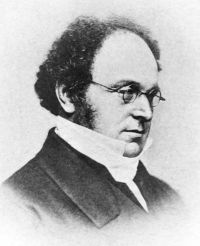
Augustus De Morgan

Augustus De Morgan

Summary

Portrait of Augustus De Morgan Augustus De Morgan Elements of arithmetic (1858)

I have said that all questions in arithmetic require nothing but addition and subtraction. I do not mean by this that no rule should ever be used except those given in the last section, but that all other rules only shew shorter ways of finding what might be found, if we pleased, by the methods there deduced. Even the last two rules themselves are only short and convenient ways of doing what may be done with a number of pebbles or counters.
Source: Gutenberg

Portrait of Augustus De Morgan Augustus De Morgan Elements of arithmetic (1858)

BOOK I. PRINCIPLES OF ARITHMETIC.
SECTION I.
NUMERATION.
1. Imagine a multitude of objects of the same kind assembled together; for example, a company of horsemen. One of the first things that must strike a spectator, although unused to counting, is, that to each man there is a horse. Now, though men and horses are things perfectly unlike, yet, because there is one of the first kind to every one of the second, one man to every horse, a new notion will be formed in the mind of the observer, which we express in words by saying that there is the same number of men as of horses.
Source: Gutenberg

Portrait of Augustus De Morgan Augustus De Morgan Elements of arithmetic (1858)

When two or more persons employ their money together, and gain or lose a certain sum, it is evidently not fair that the gain or loss should be equally divided among them all, unless each contributed the same sum. Suppose, for example, A contributes twice as much as B, and they gain £15, A ought to gain twice as much as B; that is, if the whole gain be divided into 3 parts, A ought to have two of them and B one, or A should gain £10 and B £5.
Source: Gutenberg

Get perspective with Kwize: daily news enlightened by great literature