Fraction

Definition and stakes

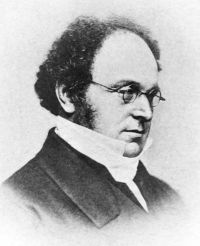
Portrait of John Casey John Casey,  The First Six Books of the Elements of Euclid

“ Thus, a fraction is denoted by two numbers parted by a horizontal line; the lower, called the denominator, denotes the number of equal parts into which the integer is divided; and the upper, called the numerator, denotes the number of these equal parts which are taken. Hence it follows, that if the numerator be less than the denominator, the fraction is less than unity. If the numerator be equal to the denominator, the fraction is equal to unity; and if greater than the denominator, it is greater than unity. ”

Source: Gutenberg

Percival Leigh,  Comic Arithmetic

“ RULE VIII.
FRACTIONS.
The word Fractions is from the Latin "Fractus," broken. A Fraction is therefore a part or broken piece. A broken head is a fraction; a broken heart is a fraction; a bankrupt is a fraction—he is [60] broken up; yet a horse is not a fraction, although he may be broken in—but his rider may have a broken neck, which is called an irreducible fraction. Speaking generally, therefore, a fraction may be considered as a "Tarnation Smashification."
FRACTIONAL SIGNS.
Fractions are of two kinds, Vulgar and Decimal.
”
Source: Gutenberg

Portrait of Silvanus Phillips Thompson Silvanus Phillips Thompson,  Calculus Made Easy (1914)

“ Case I. If we perform many additions of two or more fractions the denominators of which contain only terms in , and no terms in , , or any other powers of , we always find that the denominator of the final resulting fraction is the product of the denominators of the fractions which were added to form the result. It follows that by factorizing the denominator of this final fraction, we can find every one of the denominators of the partial fractions of which we are in search. ”
Source: Wikisource

Get perspective with Kwize: daily news enlightened by great literature