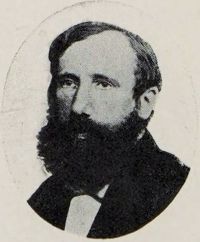
Louis-Benjamin Francœur

Biographical details

Portrait of Louis-Benjamin Francœur Louis-Benjamin Francœur,  An introduction to linear drawing (1828)

“ A prism is a body formed from two equal and parallel polygons, whose corresponding points are joined by lines, all parallel, and equal to each other; such are figures 13 to 20 inclusive.
The height of a prism is a perpendicular to the two bases. A prism is said to be upright when its sides are perpendicular, and oblique when its sides lean or are inclined.
”
Source: Wikisource

Portrait of Louis-Benjamin Francœur Louis-Benjamin Francœur,  An introduction to linear drawing (1828)

“ Each figure is accompanied with suitable explanations, so that the teacher or monitor will easily comprehend them, and be able to teach them to his classes, without much previous acquaintance with the art.
The pupils are each furnished with a slate and pencil. The monitor directs what figure shall be drawn, and if the pupils are not all furnished with this treatise, he chalks the figure on a board, painted black for the purpose, and suspended where all can see it. The slates are then examined by the monitor, and precedence is given to whichever pupil has executed the figure best.
”
Source: Wikisource

Portrait of Louis-Benjamin Francœur Louis-Benjamin Francœur,  An introduction to linear drawing (1828)

“ After having drawn a semicircle and its diameter, draw a perpendicular radius. This radius forms a right angle with the diameter, and cutting the semicircle in two equal parts or quarters of circles, leaves 90 degrees for each of them. If 90 degrees of a circle make a right angle, 45 degrees will make half a right angle, &c.
Or by another method. A radius, if made a cord of the semicircle, will allow three cords, each of which will contain 60 degrees; halve these arcs, and you have arcs of 30 degrees; halve the arcs of 30 degrees, and you have 15 degrees
”
Source: Wikisource

Get perspective with Kwize: daily news enlightened by great literature