A compass, primarily a drafting instrument used for drawing circles and arcs, has played both practical and symbolic roles across various disciplines, from geometry and navigation to literature and philosophy. While its physical form—comprising two hinged legs, a needle point, and a drawing tool—enables accurate measurements and constructions, its metaphorical significance is evident in works like Jules Verne’s A Trip to the Center of the Earth, where it becomes a symbol of natural forces, or Judah Leib Pinsker’s Auto-Emancipation, where it represents the search for historical direction.
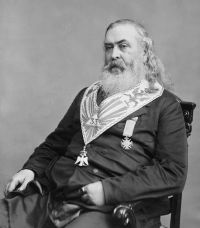
Albert Pike, in Freemasonry texts, associates it with moral integrity, presenting it as a means of balancing earthly desires against spiritual ideals. These diverse interpretations highlight the compass’s dual character: a mechanical device for precision and a deep symbol of human aspiration, connecting the concrete and the abstract.
 Judah Leib Pinsker,
Auto-Emancipation
(1916)
Judah Leib Pinsker,
Auto-Emancipation
(1916)