Declination

Definition and stakes

Anonymous,  Outline of the history of the English language and literature

“ Nowadays we have only one declension and only one inflection for the cases of nouns. That one inflection is ’s for the possessive case. The following is an example of an old declension:
Declension of EAGE, the eye.
Again, in this English, gender did not follow sex, but was poetic and fantastic. Tongue and week were feminine nouns, as they still are in modern German; star and sea, masculine; wife and child, neuter.—In old English there were a great many plural endings, as -as, -an, -u, -a, -o.
”
Source: Gutenberg

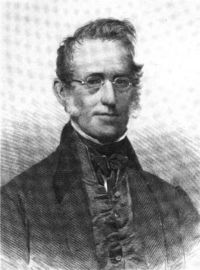
Portrait of Goold Brown Goold Brown,  The Grammar of English Grammars (1882)

“ The accent of the English language, which is constantly sounding in our ears, and every moment open to investigation, seems as much a mystery as that accent which is removed almost two thousand years from our view. Obscurity, perplexity, and confusion, run through every treatise on the subject, and nothing could be so hopeless as an attempt to explain it, did not a circumstance present itself, which at once accounts for the confusion, and affords a clew to lead us out of it. ”
Source: Wikisource

G. F. Graham,  A Book About Words

“ These always double the l in the derivative, whether the last syllable of the root be accented or not. The verb ‘to expél,’ will, by the above rule, naturally make its past tense, ‘expelled;’ but why should ‘trável’ give ‘traveller,’ or ‘équal,’ ‘equalled?’ These, though universally adopted, are clearly against the principle. Two other words are also exceptions, ‘worship,’ and ‘bias.’ These make ‘worshipped,’ and ‘biassed,’ with double consonants. The Americans refuse to admit these exceptions, and they write ‘traveler,’ ‘equaled,’ ‘worshiped,’ and ‘biased,’ with single consonants. ”
Source: Gutenberg

Get perspective with Kwize: daily news enlightened by great literature