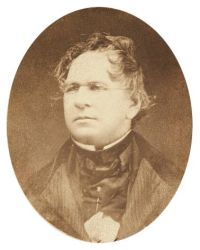
Henry Rowe Schoolcraft

Henry Rowe Schoolcraft

Summary

Portrait of Henry Rowe Schoolcraft Henry Rowe Schoolcraft Western Scenes and Reminiscences

They felt that the very air was food. It strengthened and nourished them. They wandered together over the blissful fields, where every thing was formed to please the eye and the ear. There were no tempests—there was no ice, no chilly winds—no one shivered for the want of warm clothes: no one suffered for hunger—no one mourned for the dead. They saw no graves. They heard of no wars. There was no hunting of animals; for the air itself was their food. Gladly would the young warrior have remained there forever, but he was obliged to go back for his body.
Source: Gutenberg

Portrait of Henry Rowe Schoolcraft Henry Rowe Schoolcraft Western Scenes and Reminiscences

His family had carried the incipient principles of civilization, which he gave them, too high—they had exhibited to the next age, a too prominent example of cultivation and refinement in every sense—not to feel deeply the obloquy cast upon his name, by the poetic spirit of the times; and not to wish that one who had, in verity, so many high and noble qualities, both in the council and the field, should also be without a spot on his humanity. We deem the feeling as honorable to all who have the blood of the chieftain in their veins as it is praise-worthy in his biographer.
Source: Gutenberg

Portrait of Henry Rowe Schoolcraft Henry Rowe Schoolcraft Western Scenes and Reminiscences

They believe, that at death they pass immediately to another world, where there is a large river of water to cross. They must embark in a stone canoe, and are borne along into a wide lake, which has an island in its centre. This is the island of the blest, and the object of the disembodied soul is to reach it. If their lives have been good, they will be fortunate, and make it. If bad, they will sink; but they will only sink to the depth of their chins, so that they may be permitted to behold the happy land, and strive in vain to reach it.
Source: Gutenberg

Get perspective with Kwize: daily news enlightened by great literature