Participle

Definition and stakes

Lillian Kimball,  The structure of the English sentence (1900)

“ This participle is sometimes used substantively; thus, “The loving are the daring.” “The slain were left to die.” Of course such a word as people is understood after these participles, and in analyzing these sentences it may be supplied if one so desires, but it is no more necessary than it is in the sentences,—“The good are happy, the righteous are blessed,” where a qualifying adjective is used as a noun.
2. The participial phrase as a substitute for a proposition.—We come now to those frequent and important uses of the participle where it saves a predication.
”
Source: Gutenberg

Samuel Kirkham,  English Grammar in Familiar Lectures

“ A participle with its adjuncts, may sometimes be considered as a substantive or participial phrase, which phrase may be the subject of a verb, or the object of a verb or preposition; as, "Taking from another without his knowledge or assent, is called stealing; He studied to avoid expressing himself too severely; I cannot fail of having money, &c.; By promising much and performing but little, we become despicable."
3. As the perfect participle and the imperfect tense of irregular verbs, are sometimes different in their form, care must be taken that they be not indiscriminately used.
”
Source: Gutenberg

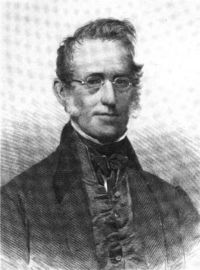
Portrait of Goold Brown Goold Brown,  The Grammar of English Grammars

“ So, if we put before it an article, an adjective, or a possessive, and thus give to the participle a substantive character or relation, there is reason to think, that we ought, in like manner, to take away its regimen, and its adverb too, if it have any, and be careful also to distinguish this noun from the participial adjective; as, "The running of a race,"—"No racing of horses,"—"Your deserving of praise."—"A man's compromising of his principles." ”
Source: Gutenberg

Get perspective with Kwize: daily news enlightened by great literature