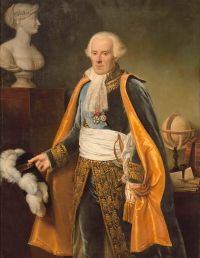
Pierre de Fermat

Definition and stakes

1911 Encyclopædia Britannica, Volume 6… (1911)

“ It was further investigated by John Wallis, Christiaan Huygens (who determined the length of any arc in 1657) , and Pierre de Fermat (who evaluated the area between the curve and its asymptote in 1661) . It is constructed in the following manner. Let APB be a semicircle, BT the tangent at B, and APT a line cutting the circle in P and BT at T; take a point Q on AT so that AQ always equals PT; then the locus of Q is the cissoid. Sir Isaac Newton devised the following mechanical construction. Take a rod LMN bent at right angles at M, such that MN = AB ”
Source: Wikisource

S. A. Reilly,  Our Legal Heritage : 600-1776 King Aethelbert - King George III

“ He and lawyer and mathematician Pierre Fermat invented the theory of probabilities. Fermat also proved that the law for refraction (bending) of light results from light's following the path that takes the shortest time. He founded number theory. Fermat formulated the notion of a line tangent to a curve and started the development of differential calculus, in which a rate of change is expressed as a function of time in equation form and also as a tangent to the curve associated with that equation.. ”
Source: Gutenberg

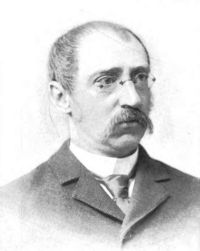
Portrait of Florian Cajori Florian Cajori,  A History of Mathematics (1893)

“ His leisure time was mostly devoted to mathematics, which he studied with irresistible passion. Unlike Descartes and Pascal, he led a quiet and unaggressive life. Fermat has left the impress of his genius upon all branches of mathematics then known. A great contribution to geometry was his De maximis et minimis. About twenty years earlier, Kepler had first observed that the increment of a variable, as, for instance, the ordinate of a curve, is evanescent for values very near a maximum or a minimum value of the variable. Developing this idea, Fermat obtained his rule for maxima and minima. ”
Source: Wikisource

Get perspective with Kwize: daily news enlightened by great literature