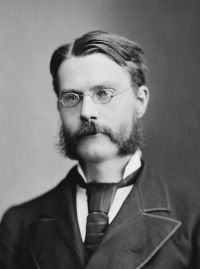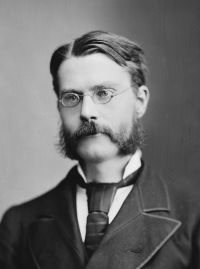
Edward Singleton Holden

Biographical details

Portrait of Edward Singleton Holden Edward Singleton Holden Sir William Herschel, his life and works (1881)

In the name of the Royal Society I present to you this gold medal, the reward which they have assigned to your successful labors, and I exhort you to continue diligently to cultivate those fields of science which have produced to you a harvest of so much honor. Your attention to the improvement of telescopes has already amply repaid the labor which you have bestowed upon them; but the treasures of the heavens are well known to be inexhaustible. Who can say but your new star, which exceeds Saturn in its distance from the sun, may exceed him as much in magnificence of attendance?
Source: Wikisource

Portrait of Edward Singleton Holden Edward Singleton Holden Popular Science Monthly (1904)

It was not until the time of Galileo that men began to see that the accepted order of heaven and earth was inverted by the new doctrine. The earth was no longer the center of the universe. The planets were not made for man, who was dethroned not only in science, but in philosophy and theology as well. It remained for more modern times to appreciate that as it was by man himself that man was so dethroned, a new glory had been added to his crown.
All men find it painful to face novel ideas, and it is but natural to seek and find sufficient reasons for avoiding painful thoughts.
Source: Wikisource

Portrait of Edward Singleton Holden Edward Singleton Holden Popular Science Monthly (1904)

We are accustomed to attribute all the merit of the change to Galileo, whose career so brilliantly represents what was best in the new scientific spirit. It is impossible to declare what the movement of the world would have been had Galileo never lived. It would, perhaps, have been much the same. A company of less brilliant men would, perhaps, have done Galileo's work, taking a century for the task. Scholasticism was already moribund; the telescope was invented; the time was ripe; Kepler had already discovered his great laws of planetary motion
Source: Wikisource

Get perspective with Kwize: daily news enlightened by great literature