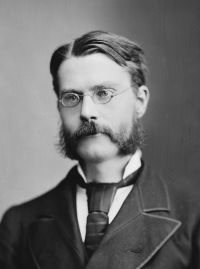
Edward Singleton Holden

Edward Singleton Holden

Summary

Portrait of Edward Singleton Holden Edward Singleton Holden Sir William Herschel, his life and works (1881)

In the name of the Royal Society I present to you this gold medal, the reward which they have assigned to your successful labors, and I exhort you to continue diligently to cultivate those fields of science which have produced to you a harvest of so much honor. Your attention to the improvement of telescopes has already amply repaid the labor which you have bestowed upon them; but the treasures of the heavens are well known to be inexhaustible. Who can say but your new star, which exceeds Saturn in its distance from the sun, may exceed him as much in magnificence of attendance?
Source: Wikisource

Portrait of Edward Singleton Holden Edward Singleton Holden Sir William Herschel, his life and works (1881)

It is indeed true that unless a particular star is of the same intrinsic brightness as our largest stars, this reasoning does not apply to it; in just so far as the average star is less bright than the average brightness of our largest stars, will the numbers which Herschel obtained be diminished. But for every star of which his hypothesis is true, we may assert that his conclusions are true, and no one can deny, with any show of reason, that, on the whole, his suppositions must be valid. On the whole, the stars which we call faint are farther from us than the brighter ones
Source: Wikisource

Portrait of Edward Singleton Holden Edward Singleton Holden Sir William Herschel, his life and works (1881)

The planet Saturn, on the contrary, seems never to have been lost sight of from the time of his first view of it in 1772.
The field of discovery always appears to be completely occupied until the advent of a great man, who, even by his way of putting old and familiar facts, shows the paths along which discoveries must come, if at all. This faculty comes from profound reflection on the nature of the subject itself, from a sort of transmuting power which changes the words of the books into the things of reality. Herschel's paper on Saturn, in 1790, is an admirable example of this.
Source: Wikisource

Get perspective with Kwize: daily news enlightened by great literature