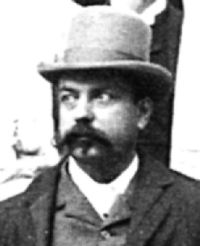
Albert Houtum-Schindler

Albert Houtum-Schindler

Summary

Portrait of Albert Houtum-Schindler Albert Houtum-Schindler 1911 Encyclopædia Britannica (1911)

From the junction of the two principal sources in the Zardeh Kuh at an altitude of about 8000 ft., the Ab i Kurang is a powerful stream, full, deep and flowing with great velocity for most of its upper course between precipices varying in height from 1000 to 3000 ft. The steepness and height of its banks make it in general useless for irrigation purposes. From its principal sources to Shushter the distance as the crow flies is only about 75 m., but the course of the river is so tortuous that it travels 250 m.
Source: Wikisource

Portrait of Albert Houtum-Schindler Albert Houtum-Schindler 1911 Encyclopædia Britannica (1911)

On the eastern side of the city stand the ruins of the Masjed i jehan Shah, commonly known as the Masjed i Kebud, or “Blue Mosque,” from the blue glazed tiles which cover its walls. It was built by Johan Shah of the Kara Kuyunli, or Black Sheep dynasty (1437–1467) . [1] Tabriz is celebrated as one of the most healthy cities in Persia.
Source: Wikisource

Portrait of Albert Houtum-Schindler Albert Houtum-Schindler 1911 Encyclopædia Britannica (1911)

TABRIZ, the capital of the province of Azerbaijan in Persia, situated in the valley of the Aji Chai, “Bitter River,” at an elevation of 4400 ft. in 38° 4′ N., 46° 18′ E. Based on a census taken in 1871 the population of Tabriz was in 1881 estimated at 165,000, and is now said to be about 200,000.
The popular etymology of the name Tabriz from tab=fever, rīz=pourer away (verb, rīkhtan=pour away, flow; German rieseln?) , hence “fever-destroying,” is erroneous and was invented in modern times.
Source: Wikisource

Get perspective with Kwize: daily news enlightened by great literature