Alexander Francis Chamberlain

Alexander Francis Chamberlain

Summary

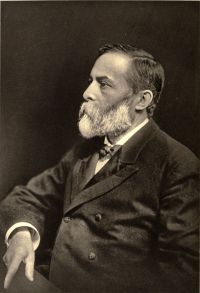
Portrait of Alexander Francis Chamberlain Alexander Francis Chamberlain Popular Science Monthly (1912)

Its vocabulary always has "the open door." It admits on the same conditions a word from Ojibwa or from Greek; one from Latin or from Polynesian. If the right word turns up at the right time, there is no Academy to pass judgment upon it, grammatically or lexicographically. The sole authority to welcome or to reject is the genius of the language itself. Tammany and telephone, taboo and aeroplane, all come into our common speech with equal rights to citizenship. English is thus dependent upon no one language, or even set of languages, for the accretion of its vocabulary.
Source: Wikisource

Portrait of Alexander Francis Chamberlain Alexander Francis Chamberlain Popular Science Monthly (1912)

And this is but one example of the attempts to make the classical tail wag the English dog. Did English tolerate no hybrids, we should be without Christmas, dislike, grateful, pastime, becalm, dishearten, and many more of our common words. And where were the "purists" and the classicists when, in response to the needs of the political or the scientific moments, as the case might be, anti-Tammany, near-genius, re-tattooing, pre-totemic, pseudo-mugwump, semi-taboo and other interesting terms came into being? Hybridity is no efficient scarecrow for such a tongue as modern English.
Source: Wikisource

Portrait of Alexander Francis Chamberlain Alexander Francis Chamberlain Popular Science Monthly (1912)

In American English, in particular, the only memorial existing of some now extinct and forgotten tribe of savages may be some such word which has won a place in our hospitable lexicon. On the other hand, the united efforts of all the "purists" in the land are often insufficient to secure permanent footing for some new coinage, whose classical parentage is quite unimpeachable and whose grammatical attire forbids criticism. Very often does our language illustrate the truth of the old saying, "the first shall be last, and the last shall be first."
Source: Wikisource

Get perspective with Kwize: daily news enlightened by great literature