Summary

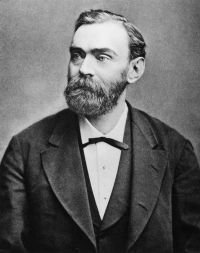
Portrait of Alfred Nobel Alfred Nobel U.S. Patent 50617 Reissue 4818…

The effect of these combinations will produce an explosive especially suitable for certain blast­ing purposes—for example, in crevice rock—and greatly superior either to gunpowder or gun-cotton in explosive force, and quite readily exploded, so that it may be fired and exploded by means of a match or electric spark in like manner as gunpowder or gun-cotton alone.
Source: Wikisource

Portrait of Alfred Nobel Alfred Nobel U.S. Patent 50617 Reissue 4818…

Nitro-glycerine, for example, if ignited in an open space, is slowly decomposed and takes fire; but the flame is apt to die out when the match is withdrawn; hence it cannot under ordinary circumstances be looked upon as a ready explosive agent, for while gunpowder and other substances used as explosives prior to NOBEL'S invention, al­ways explode or deflagrate throughout their whole mass when fire is set to them, nitro­glycerine and the analogous substances before named will not explode from the mere contact of flame.
Source: Wikisource

Portrait of Alfred Nobel Alfred Nobel U.S. Patent 50617 Reissue 4818…

There is a class of explosives long known, but not at the date of NOBEL'S invention ap­plied to technical purposes, in consequence of practical difficulties in procuring their explo­sion. Such substances are nitro-glycerine, the nitrates of ethyl and of methyl and nitro­manite. These substances are liquid at ordi­nary temperatures, and, by that characteristic are distinguishable from solid explosives, such as gunpowder, gun-cotton, &c.; and they have also the property that fire may be applied to them without their exploding.
Source: Wikisource

Get perspective with Kwize: daily news enlightened by great literature