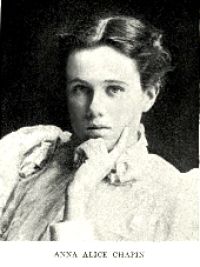
Anna Alice Chapin

Anna Alice Chapin

Summary

Portrait of Anna Alice Chapin Anna Alice Chapin The Woman With a Past — XVIII. The Caravan (1912–14)

Already the fog that she had come to watch for was forming, soft as smoke, above the freshening, ruffled waves.
“I think I must travel with my own caravan,” she said. “I have some ghosts in my retinue that I cannot lay.”
“And why,” asked the wanderer, “do you want to lay them?”
“Because,” said Pippa, and her mind flashed back to the day when she had talked to a foolish girl of the ways in which ghosts are made, “because they are not, for the most part, happy ghosts. They represent everything that has made me what I am.”
Source: Wikisource

Portrait of Anna Alice Chapin Anna Alice Chapin The Woman With a Past — XVIII. The Caravan (1912–14)

Philippa smiled.
“You say very pretty things,” she said. “Please tell me your name, and who you are.”
“My name, madame, is Mohammed Ali, one-time camel driver of the fastest mail camel in all Egypt—Fatma, who could outfly the wind itself, a beast as far from the common pigs that the Bisharin ride as is the sun from a candle flame, or the sword from the tent peg!”
Pippa had learned to let men tell their tales in their own way, so she merely nodded appreciatively, and let him talk on without interruption.
Source: Wikisource

Portrait of Anna Alice Chapin Anna Alice Chapin The Woman With a Past — XVIII. The Caravan (1912–14)

She thought of what Mohammed Ali had said of ghosts and dreams. She looked at the wanderer, but the tears rushed hotly to her eyes. She could not answer.
“You know,” the man said, as gently as before, “nobody is what they have done—only what they are.”
“Yes.” Philippa knew that; she could not have lived otherwise.
“You do know that? Then why are you so unkindly disposed toward your ghosts? The ghosts that have shaped you, given you life and strength and character and the power to do many things.”
Source: Wikisource

Get perspective with Kwize: daily news enlightened by great literature