Summary

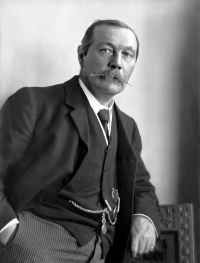
Portrait of Arthur Conan Doyle Arthur Conan Doyle The Great Boer War — Chapter 23 The Clearing of the South-East (1900)

Wepener, Mafeking, Kimberley, the taking of the first guns at Ladysmith, the deeds of the Imperial Light Horse--it cannot be denied that our irregular South African forces have a brilliant record for the war. They are associated with many successes and with few disasters. Their fine record cannot, I think, be fairly ascribed to any greater hardihood which one portion of our race has when compared with another, for a South African must admit that in the best colonial corps at least half the men were Britons of Britain.
Source: Wikisource

Portrait of Arthur Conan Doyle Arthur Conan Doyle The Great Boer War — Chapter 23 The Clearing of the South-East (1900)

Ian Hamilton, who had already done good service in the war, having commanded the infantry at Elandslaagte, and been one of the most prominent leaders in the defence of Ladysmith, takes from this time onwards a more important and a more independent position. A thin, aquiline man, of soft voice and gentle manners, he had already proved more than once during his adventurous career that he not only possessed in a high degree the courage of the soldier, but also the equanimity and decision of the born leader.
Source: Wikisource

Portrait of Arthur Conan Doyle Arthur Conan Doyle The Great Boer War — Chapter 23 The Clearing of the South-East (1900)

Every requisite for a great victory was there except the presence of an enemy. The Wepener siege had been raised and the force in front of Rundle had disappeared as only Boer armies can disappear. The combined movement was an admirable piece of work on the part of the enemy. Finding no force in front of them, the combined troops of French, Rundle, and Chermside occupied Dewetsdorp, where the latter remained, while the others pushed on to Thabanchu, the storm centre from which all our troubles had begun nearly a month before.
Source: Wikisource

Get perspective with Kwize: daily news enlightened by great literature