“ Ian Hamilton, in spite of the long marches his troops had made, was impatient to push on from Winburg without delay, and, following the track to Ventersburg, to seize the drifts across the Sand River, twenty miles to the north. The great speed of his last movement had outpaced the Boers, and their convoys were struggling along abreast of, and even behind, the British column, trying vainly to slip across our front, and join the burgher forces accumulating for the defence of Kroonstadt. ”
Quotes about “Ian Hamilton”
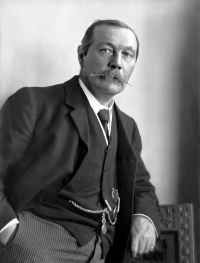 Arthur Conan Doyle,
The Great Boer War — Chapter 23 The Clearing of the South-East
(1900)
Arthur Conan Doyle,
The Great Boer War — Chapter 23 The Clearing of the South-East
(1900)
“ Ian Hamilton, who had already done good service in the war, having commanded the infantry at Elandslaagte, and been one of the most prominent leaders in the defence of Ladysmith, takes from this time onwards a more important and a more independent position. A thin, aquiline man, of soft voice and gentle manners, he had already proved more than once during his adventurous career that he not only possessed in a high degree the courage of the soldier, but also the equanimity and decision of the born leader. ”
“ The soldiers munched their biscuits silently under the sun blaze. The officers and staff ate a frugal luncheon. Ian Hamilton with his aide-de-camp, the Duke of Marlborough, shared the contents of my wallets. I watched the General closely. He knew better than the sanguine people who declared the Boers had run away already. No one understood better than he what a terrible foe is the rock-sheltered Mauser-armed Dutchman. In spite of its cavalry turning movement, and other embellishments, the impending attack must be practically frontal. Supply did not allow a wider circle: to stop was to starve ”
“ IAN HAMILTON'S ACTION BEFORE JOHANNESBURG The left attack, pressed with vigour, and directed with skill by General Bruce-Hamilton, led along a low spur, and was designed to be a kind of inside turning movement to assist the right in conformity with the Cavalry action now in full swing. The City Imperial Volunteers moved forward with great dash and spirit, and in spite of a worrying fire from their left rear, which increased in proportion as they moved inwards towards the right, drove the Boers from position after position. ”
Various, Encyclopaedia Britannica, 11th Edition…
“ His eldest son, James Hamilton of Cadzow, like his father and great-grandfather, visited England as a prisoner, being one of the hostages for the king’s ransom. From him the Hamiltons of Silvertonhill and the lords Hamilton of Dalzell claim descent, among the more distinguished members of the former branch being General Sir Ian Hamilton, K.C.B. James Hamilton was succeeded by his eldest son Sir James Hamilton of Cadzow, who was created in 1445 an hereditary lord of parliament, and was thereafter known as Lord Hamilton. ”
Ian Hamilton, Sir Ian Hamilton's Despatches from the Dardanelles…
“ Laurence enabled General Wolfe to capture Quebec in 1759, so Admiral John de Robeck has enabled General Sir Ian Hamilton to land his troops and hold the western coast of the Gallipoli Peninsula, and Hamilton, happier than Wolfe, lives to acknowledge his debt to the Senior Service, describing it affectionately as "The father and mother of the Army." ”
“ There was--so it has been described to me--a long donga that led up the steep slope. Into the lower end of this the Boer horsemen disappeared. Hamilton moved his score of men a little to their right, where they might command this zig-zag approach as much as the broken ground would allow, and reported again to the General or whoever was directing affairs--for Colley, wearied with the tremendous exertion of the night climb, was sleeping--'Enemy advancing to attack.' He also made a few stone shelters. ”
“ He must move still more to the west. On the other hand, Hamilton, whose force was eating its last day's rations, could make no longer détour, and must break through there and then--frontal attack, if necessary. So all fitted in happily. The Cavalry division moved to the left to co-operate with the Infantry attack by threatening the Boer right, and, in order that this pressure might be effective, Hamilton lent Broadwood's Brigade and two corps of Mounted Infantry to French for the day. He himself prepared to attack what stood before him with his whole remaining force. ”
Ian Hamilton, Gallipoli Diary, Volume 1
“ Death on the eve of battle, death on a wedding day—nothing so tragic save that most black mishap, death in action after peace has been signed. Death grins at my elbow. I cannot get him out of my thoughts. ”
Ian Hamilton, Gallipoli Diary, Volume 1
“ To sleep whilst thousands are killing one another close by! Well, why not; I must sleep whilst I may. The legend whereby a Commander-in-Chief works wonders during a battle dies hard. He may still lose the battle in a moment by losing heart. He may still help to win the battle by putting a brave face upon the game when it seems to be up. ”
“ The principle was indisputable; but, of course, in practice it resolved itself into another instance of balancing drawbacks, for delay gave the enemy time to get his breath, and meant that the Sand River passage would be opposed. Besides, if the Boers had flung all their strength upon Hamilton, we were 7,000 bayonets, 3,000 horse, and nearly forty guns, and would have beat them off with a shocking slaughter. ”
Ian Hamilton, Gallipoli Diary, Volume 2
“ The blessed cable is now lying on the well-known desk where K. will frown at it through his enormous spectacles. Then he calls the Adjutant-General and tells him Hamilton must be mad as all his formations are full to overflowing and yet he says he is 45,000 short. Next enters the Master-General of the Ordnance with a polite bow and K. tells him Hamilton must be delirious as he keeps on raving for shell, bombs, grenades although as he, Von Donop, knows well, he has been sent more guns and explosives than any man has ever enjoyed in war. ”
“ The town--a town of brick and tin--stands at the apparent edge of a vast plain of withered grass, from whose inhospitable aspect it turns and nestles, as if for protection, round the scrub-covered hills to northward. From among the crowd of one-storied dwelling-houses, more imposing structures, the seats of Government and commerce, rise prominently to catch the eye and impress the mind with the pleasing prospect of wealthier civilisation. ”
Ian Hamilton, Gallipoli Diary, Volume 1
“ The stretcher-bearers carry their burdens over a carpet of flowers. Life is here around us in its most exquisite forms. Those flowers! Poppies, cornflowers, lilies, tulips whose colours are those of the rainbow. The coast line curving down and far away to meet the extravagant blueness of the Aegean where the battleships lie silent—still—smoke rising up lazily—and behind them, through the sea haze, dim outlines of Imbros and Samothrace. ”
“ Merry military music, laughing faces, bright, dainty little caps, a moving throng, and the consciousness that this means a victorious British Army in the capital of the Free State, drive away all shadows from the mind.One cannot see any gaps in the crowd; it is so full of animation that the spaces where Death has put his hand are not to be seen. The strong surges of life have swept across them as a sunny sea closes over the foundered ship. ”
Ian Hamilton, Gallipoli Diary, Volume 1
“ From the trenches that ran along the crest a hot fire was being kept up, and swarms of bullets sang through the air, far overhead for the most part, to drop into the sea that lay around us. Yet all the time there were full five hundred men fooling about stark naked on the water's edge or swimming, shouting and enjoying themselves as it might be at Margate. ”
“ A Merry Christmas! to a prisoner--not when his countrymen, victorious and full of enthusiasm, are marching rapidly to his release, but when the armies of his country, beaten back, lie far away; when, helpless himself, despair seizes his heart; when reverses grow into disasters and the might of the dear old land in which he trusted seems to have weakened and died. ”
Ian Hamilton, Gallipoli Diary, Volume 1
“ Buildings gutted: walls and trenches turned inside out and upside down: friend and foe surely must be wiped out together under such a fire: at least they are stupefied—must cease taking a hand with their puny rifles and machine guns? Not so. Amidst falling ruins; under smoke clouds of yellow, black, green and white; the beach, the cliffs and the ramparts of the Castle began, in the oncoming dusk, to sparkle all over with hundreds of tiny flecks of rifle fire. ”
Ian Hamilton, Gallipoli Diary, Volume 1
“ The French have suffered severely but are in fine fighting form. They are enchanted to hear about their second Division. For some reason or another they have made up their minds that France is not so keen as we are to make a present of Constantinople to Russia. Their intelligence on European questions seems much better than ours and they depress me by expressing doubts as to whether the Grand Duke Nicholas has munitions enough to make further headway against the Turks in the Caucasus: also, as to whether he has even stuff enough to equip Istomine and my rather visionary Army Corps. ”
Ian Hamilton, Gallipoli Diary, Volume 1
“ Other swarms of half-naked soldiers are sweating, hauling, unloading, loading, road-making; dragging mules up the cliff, pushing mules down the cliff: hundreds more are bathing, and through this pandemonium pass the quiet stretchers bearing pale, blood-stained, smiling burdens. ”
Ian Hamilton, Gallipoli Diary, Volume 2
“ My opinion now is that it would not be wise to reckon on getting out of Gallipoli with less loss than that of half the total force as well as guns, which must be used to the last, stores, railway plant and horses. Moral of those who got off would fall very low. ”
Ian Hamilton, Gallipoli Diary, Volume 1
“ Moreover the number of howitzers, guns and rifles in France is so enormous that it is morally impossible they should all be hotly engaged at the same time. Thus they automatically form their own reserves. In other words, a force possessing only ten howitzers ought to have at least twice the reserves of a force possessing a hundred howitzers. ”
Ian Hamilton, Gallipoli Diary, Volume 2
“ When, at a crisis, a boiler walks into the middle of his calculations, a soldier is simply—boiled! I could not altogether master my irritation, and I wrote out a reply saying this was not a question of convenience or inconvenience but one of preventing a Commander-in-Chief from exercising his functions during battle. ”
Ian Hamilton, Gallipoli Diary, Volume 1
“ What a change since the War Office sent us packing with a bagful of hallucinations. Naval guns sweeping the Turks off the Peninsula; the Ottoman Army legging it from a British submarine waving the Union Jack; Russian help in hand; Greek help on the tapis. Now it is our Fleet which has to leg it from the German submarine; there is no ammunition for the guns; no drafts to keep my Divisions up to strength; my Russians have gone to Galicia and the Greeks are lying lower than ever. ”
Ian Hamilton, Gallipoli Diary, Volume 1
“ Did we land far away to the Westward we must still march round the marsh, or else we must cross it on one single road whose long and easily destructible bridges we could see spanning the bog holes some three miles inland. Opposite the fortified lines we stood in to within easy field gun range, trusting that the Turks would not wish prematurely to disclose their artillery positions. So we managed a peep at close quarters, and were startled to see the ramifications and extent of the spider's web of deep, narrow trenches along the coast and on either front of the lines of Bulair. ”
Ian Hamilton, Gallipoli Diary, Volume 1
“ Never, since modern battles were invented by the Devil, has a Commander-in-Chief been so accessible to a message or an appeal from any part of the force. Each theatre has its outfit of signallers, wireless, etc., and I can either answer within five minutes, or send help, or rush myself upon the scene at 25 miles an hour with the Q.E.'s fifteen inchers in my pocket. ”
Ian Hamilton, Gallipoli Diary, Volume 1
“ Faced by a heavy artillery, machine gun and rifle fire our troops, French and British alike, made a fine effort; the French especially got well into the Turks with the bayonet, and all along, excepting on our extreme left, our line gained ground. I might represent the battle as a victory, as the enemy's advanced positions were driven in, but essentially the result has been failure, as the main object remains unachieved. The fortifications and their machine guns were too scientific and too strongly held to be rushed, although I had every available man in to-day. ”
Ian Hamilton, Gallipoli Diary, Volume 1
“ It would have melted a heart of stone, Hunter-Weston said, to see how tired our men looked in the grey of morning when my order came to hand urging them to counter-attack and pursue. Not the spirit but the flesh failed them. With a fresh Division on the ground nothing would have prevented us from making several thousand prisoners; whether they would have been able to rush the machine guns and so gain a great victory was more problematical. Anyway, our advance at dawn was half heroic, half lamentable. The men were so beat that if they tripped and fell, they lay like dead things. ”
Ian Hamilton, Gallipoli Diary, Volume 1
“ Whether by hours or by years, by inches or by leagues, by bullets or bacilli, we struggle-for-lifers will very soon struggle no more. My last salaams are well-nigh due to my audience and to the stage. That rare and curious being called I is more fragile than any porcelain jar. How on earth it has preserved itself so long, heaven only knows. One pellet of lead, it falls in a heap of dust; the Peninsula [Pg 348] disappears; the fighting men fall asleep; the world and its glories become a blank—not even a dream—nothing! ”
Ian Hamilton, Sir Ian Hamilton's Despatches from the Dardanelles…
“ The high ground overlooking the beach was strongly fortified with trenches to which the gully afforded a natural covered approach. A number of machine guns also were cunningly tucked away into holes in the cliff so as to be immune from a naval bombardment whilst they were converging their fire on the wire entanglements. The crest of the hill overlooking the beach was in its turn commanded by high ground to the north-west and south-east, and especially by two strong infantry redoubts near point 138. ”
Ian Hamilton, Gallipoli Diary, Volume 1
“ Now big guns have been brought from Chatalja, Adrianople and elsewhere,—roads have been made,—heavy movable armaments provided,—troops and machine guns have been poured into the Peninsula,—several lines of trenches have been dug,—every landing place has been trenched and mined, and all that clever German Officers under Von der Goltz can design, and hard working diggers like the Turks can carry out, has been done to make the Peninsula impregnable. ”
Ian Hamilton, Gallipoli Diary, Volume 1
“ Landing some New Zealand Mounted Rifles at Anzac, the destroyer anchored within range of the Turkish guns instead of slowly steaming about out of range until the picket boats came off to bring the men ashore. The Turks were watching and, as soon as she let go her anchor, opened fire from their guns by the olive, and before the destroyer could get under weigh six of these fine New Zealand lads were killed and forty-five wounded. A hundred fair fighting casualties would affect me less. ”
Ian Hamilton, Sir Ian Hamilton's Despatches from the Dardanelles…
“ The Turkish right rested upon the steep cliff north-east of Y beach, where the King's Own Scottish Borderers and the Plymouth Battalion, Royal Naval Division, had made their first landing. Since those days the enemy had converted the bluff into a powerful bastion, from which the fire of machine-guns had held up the left of our attacks. ”
Ian Hamilton, Gallipoli Diary, Volume 2
“ By surprise either Army can bulge in a sector of the opposing lines but, until one Army loses its moral, neither Army can break through. An engine will be found to restore marches and manœuvres but, at this historic moment, our tactics are at that stage. To break through, Armies must advance some six or seven miles; otherwise they can't bag the enemy's big guns. But, the backbone of their attack, their own guns, can't support them when they get beyond five or six miles. ”
