Summary

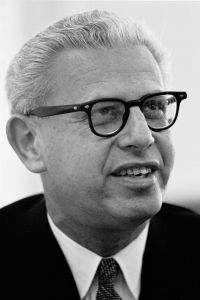
Portrait of Arthur Goldberg Arthur Goldberg,  Zemel v. Rusk — Dissent

“ Through travel, by private citizens as well as by journalists and governmental officials, information necessary to the making of informed decisions can be obtained. And, under our constitutional system, ultimate responsibility for the making of informed decisions rests in the hands of the people. As Professor Chafee has pointed out, 'An American who has crossed the ocean is not obliged to form his opinions about our foreign policy merely from what he is told by officials of our government or by a few correspondents of American newspapers. ”
Source: Wikisource

Portrait of Arthur Goldberg Arthur Goldberg,  Zemel v. Rusk — Dissent

“ Surely travel restrictions imposed while the United States was at war and a single telegram instructing ministers to deny emergency passports for a brief time in 1915 for travel to a theatre of war, do not show that Congress, by re-enacting the 1856 Act in 1926, intended to authorize the Executive to impos area restrictions upon travel in peacetime whenever the Executive believed such restrictions might advance American foreign policy. ”
Source: Wikisource

Portrait of Arthur Goldberg Arthur Goldberg,  Zemel v. Rusk — Dissent

“ During the War of 1812 Congress specifically provided by statute that persons could not cross enemy lines without a passport, and in 1861 at the beginning of the Civil War the Secretary of State ruled that passports would not be issued to persons whose loyalty was in doubt. These restrictions were imposed in time of war. The first, restricting the area of travel, evidently was thought to require a specific statutory enactment by Congress, and the second did not limit the area of travel, but, rather, limited the persons to whom passports would be issued. ”
Source: Wikisource

Get perspective with Kwize: daily news enlightened by great literature