Summary

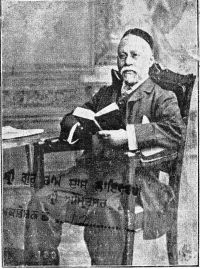
Portrait of Behramji Malabari Behramji Malabari Gujarát and the Gujarátis — The Shráwan Más (1882)

A few paces behind her is the robustious Márwáran, shuffling past in her cumbrous ugly petticoat. She is a big strapping body, and the tread of her bejewelled foot is extremely assertive. She, or perhaps her lord, has peculiar notions of personal adornment. She throws her sári around, or, rather, shrouds herself in her sári, till every vestige of her face is invisible. She wears ivory bangles or rings on her arms—both arms are literally covered by these ponderous articles. The palms of her hands, and the nails, the Márwáran dyes red, and the lips and teeth black!
Source: Wikisource

Portrait of Behramji Malabari Behramji Malabari Gujarát and the Gujarátis — The Shráwan Más (1882)

The Márwáran is more parsimonious than her lord, and though she is constrained to take some cheap offering to the gods once or twice in the year, she does not scruple to bring part of it back, thus cheating deity itself! The Márwáran is a rare phenomenon in Native society. She is purchased by the husband at a fearful cost. The Márwári does not marry till late in life.
Source: Wikisource

Portrait of Behramji Malabari Behramji Malabari Gujarát and the Gujarátis — The Shráwan Más (1882)

To the stranger the Shráwan festival is the most innocent and least grotesque of the numerous so-called national festivals. It resembles the Christmas more than any other Hindu holiday. Members of a family that may have left the family-hearth on various purposes, meet again; old quarrels are made up, the sacred thread is changed, the new dress is put on (in too many cases the only new dress of the year!) , the flower and fruit offerings are placed before the gods.
Source: Wikisource

Get perspective with Kwize: daily news enlightened by great literature