Summary

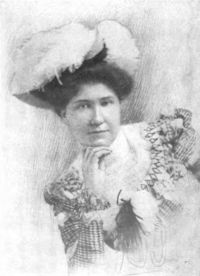
Portrait of Carolyn Wells Carolyn Wells More Lives Than One — XVI. Lorimer Lane (1923)

There is no one in the world for me, but the man you call I. My Tommy—my own Tommy Locke.”
“Yes—Pearl Jane—your own Tommy Locke. Good-by, sweetheart, I daren’t stay longer. Trust me through all mysteries, and some day we can be happy together.
“Really, Tommy?”
“Really, dear. Good-by.
Pearl Jane was bewildered, but happy. Tommy was in explicable, but she knew—she knew he was no murderer, or criminal of any sort. He was her Tommy, and some day they would be happy together. He had said so, and that was enough for Pearl Jane.
Source: Wikisource

Portrait of Carolyn Wells Carolyn Wells More Lives Than One — XVI. Lorimer Lane (1923)

Her brain was clear, though her nerves were jumping. But she had one fixed principle to follow. Tommy had told her to tell the truth. He had emphasized that. So she did.
She parried only a moment. “Is that a statement or a question?” she said.
Lane stared at her. She certainly was surprising.
“I’ll make it a question,” he said; “do you think Mr. Locke killed Mrs. Barham?”
“It’s hard to answer,” she said, with a thoughtful look. “I can’t think it—and yet—yes, I do suspect him.”
“And you still deem him an honorable man?”
“Yes, I do.”
“Do honorable men commit murder?”
Source: Wikisource

Portrait of Carolyn Wells Carolyn Wells More Lives Than One — XVI. Lorimer Lane (1923)

These things would redound to the grief and pain of my wife’s mother, an elderly lady, and also to the disparagement, even disgrace of my wife’s memory. I hold that the only good done by a solution of the mystery of her death would be the punishment of the murderer. While we all feel that such a crime should be avenged, I, myself, would rather never know the truth, than to expose all.”
“I understand and appreciate, Mr. Barham, your attitude, but I cannot look at it as you do. Moreover, the police are not willing to look at it in that light, either.
Source: Wikisource

Get perspective with Kwize: daily news enlightened by great literature