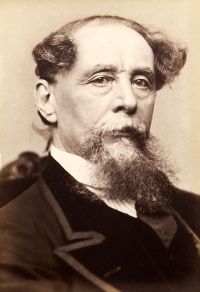
Charles Dickens

Charles Dickens

Summary

Portrait of Charles Dickens Charles Dickens,  Barnaby Rudge — Chapter 16 (1841)

“ Among all the dangerous characters who, in such a state of society, prowled and skulked in the metropolis at night, there was one man from whom many as uncouth and fierce as he, shrunk with an involuntary dread. Who he was, or whence he came, was a question often asked, but which none could answer. His name was unknown, he had never been seen until within about eight days or thereabouts, and was equally a stranger to the old ruffians, upon whose haunts he ventured fearlessly, as to the young. ”
Source: Wikisource

Portrait of Charles Dickens Charles Dickens,  Barnaby Rudge — Chapter 16 (1841)

“ The oil and cotton lamps, though regularly trimmed twice or thrice in the long winter nights, burnt feebly at the best; and at a late hour, when they were unassisted by the lamps and candles in the shops, cast but a narrow track of doubtful light upon the footway, leaving the projecting doors and house-fronts in the deepest gloom. Many of the courts and lanes were left in total darkness; those of the meaner sort, where one glimmering light twinkled for a score of houses, being favoured in no slight degree. ”
Source: Wikisource

Portrait of Charles Dickens Charles Dickens,  Barnaby Rudge — Chapter 16 (1841)

“ Long stands of hackney-chairs and groups of chairmen, compared with whom the coachmen of our day are gentle and polite, obstructed the way and filled the air with clamour; night-cellars, indicated by a little stream of light crossing the pavement, and stretching out half-way into the road, and by the stifled roar of voices from below, yawned for the reception and entertainment of the most abandoned of both sexes; under every shed and bulk small groups of link-boys gamed away the earnings of the day ”
Source: Wikisource

Get perspective with Kwize: daily news enlightened by great literature