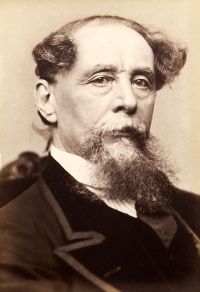
Charles Dickens

Charles Dickens

Summary

Portrait of Charles Dickens Charles Dickens,  Barnaby Rudge — Chapter 32 (1841)

“ Good God, how very coarse!’
‘I was about to speak to you from my heart, sir,’ returned Edward, ‘in the confidence which should subsist between us; and you check me in the outset.’
‘Now do, Ned, do not,’ said Mr Chester, raising his delicate hand imploringly, ‘talk in that monstrous manner. About to speak from your heart. Don’t you know that the heart is an ingenious part of our formation—the centre of the blood-vessels and all that sort of thing—which has no more to do with what you say or think, than your knees have? How can you be so very vulgar and absurd?
”
Source: Wikisource

Portrait of Charles Dickens Charles Dickens,  Barnaby Rudge — Chapter 32 (1841)

“ I am very sorry, but there’s really no alternative.’
‘The curse may pass your lips,’ said Edward, ‘but it will be but empty breath. I do not believe that any man on earth has greater power to call one down upon his fellow—least of all, upon his own child—than he has to make one drop of rain or flake of snow fall from the clouds above us at his impious bidding.
”
Source: Wikisource

Portrait of Charles Dickens Charles Dickens,  Barnaby Rudge — Chapter 32 (1841)

“ I know your creed, sir, and will say no more,’ returned his son.
‘There again,’ said Mr Chester, sipping his wine, ‘you are wrong. I distinctly say there are such things. We know there are. The hearts of animals—of bullocks, sheep, and so forth—are cooked and devoured, as I am told, by the lower classes, with a vast deal of relish. Men are sometimes stabbed to the heart, shot to the heart; but as to speaking from the heart, or to the heart, or being warm- hearted, or cold-hearted, or broken-hearted, or being all heart, or having no heart—pah!
”
Source: Wikisource

Get perspective with Kwize: daily news enlightened by great literature