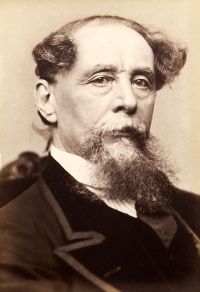
Charles Dickens

Charles Dickens

Summary

Portrait of Charles Dickens Charles Dickens,  Barnaby Rudge — Chapter 47 (1841)

“ How much?’
‘He’s not to be sold,’ replied Barnaby, shutting up the basket in a great hurry, and throwing the strap over his shoulder. ‘Mother, come away.’
‘Thou seest how much of an idiot he is, book-learner,’ said the gentleman, looking scornfully at his wife. ‘He can make a bargain. What dost want for him, old woman?’
‘He is my son’s constant companion,’ said the widow. ‘He is not to be sold, sir, indeed.’
‘Not to be sold!’ cried the gentleman, growing ten times redder, hoarser, and louder than before.
”
Source: Wikisource

Portrait of Charles Dickens Charles Dickens,  Barnaby Rudge — Chapter 47 (1841)

“ He was warmly attached to church and state, and never appointed to the living in his gift any but a three-bottle man and a first-rate fox-hunter. He mistrusted the honesty of all poor people who could read and write, and had a secret jealousy of his own wife (a young lady whom he had married for what his friends called ‘the good old English reason,’ that her father’s property adjoined his own) for possessing those accomplishments in a greater degree than himself. In short, Barnaby being an idiot, and Grip a creature of mere brute instinct, it would be very hard to say what this gentleman was. ”
Source: Wikisource

Portrait of Charles Dickens Charles Dickens,  Barnaby Rudge — Chapter 47 (1841)

“ Ye don’t want to sell the bird, ye that come here to beg, don’t ye? If they an’t out in double-quick, set the dogs upon ’em!’
They waited for no further dismissal, but fled precipitately, leaving the gentleman to storm away by himself (for the poor lady had already retreated) , and making a great many vain attempts to silence Grip, who, excited by the noise, drew corks enough for a city feast as they hurried down the avenue, and appeared to congratulate himself beyond measure on having been the cause of the disturbance.
”
Source: Wikisource

Get perspective with Kwize: daily news enlightened by great literature