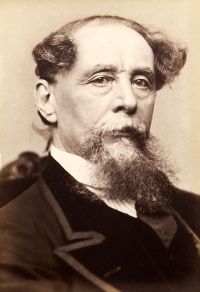
Charles Dickens

Charles Dickens

Summary

Portrait of Charles Dickens Charles Dickens,  Barnaby Rudge — Chapter 79 (1841)

“ In truth his pale and haggard face, and gloomy bearing, had so far influenced the remark, that Edward was, for the moment, at a loss to answer him.
‘Tut, tut,’ said Mr Haredale, ''twas not very difficult to read a thought so natural. But you are mistaken nevertheless. I have had my share of sorrows—more than the common lot, perhaps, but I have borne them ill. I have broken where I should have bent; and have mused and brooded, when my spirit should have mixed with all God’s great creation. The men who learn endurance, are they who call the whole world, brother.
”
Source: Wikisource

Portrait of Charles Dickens Charles Dickens,  Barnaby Rudge — Chapter 79 (1841)

“ The crowd assenting, substituted Gabriel Varden for the nothing particular; and giving him one over, for good measure, dispersed in high good-humour.
What congratulations were exchanged among the inmates at the Golden Key, when they were left alone; what an overflowing of joy and happiness there was among them; how incapable it was of expression in Barnaby’s own person; and how he went wildly from one to another, until he became so far tranquillised, as to stretch himself on the ground beside his mother’s couch and fall into a deep sleep; are matters that need not be told.
”
Source: Wikisource

Portrait of Charles Dickens Charles Dickens,  Barnaby Rudge — Chapter 79 (1841)

“ He is an older man than I; but nothing can conquer him.’
‘The cheeriest, stoutest-hearted fellow in the world.’
‘He has a right to be. He has a right to he. A better creature never lived. He reaps what he has sown—no more.’
‘It is not all men,’ said Edward, after a moment’s hesitation, ‘who have the happiness to do that.’
‘More than you imagine,’ returned Mr Haredale. ‘We note the harvest more than the seed-time.
”
Source: Wikisource

Get perspective with Kwize: daily news enlightened by great literature