“ You are supposed to be on a visit to London for a few days. It is lucky you have no maid to make [296] mischief. I must return to Haredale this evening. Let me tell your father that I have explained everything to you, that you are coming back on Monday or Tuesday, and that Miss Carden will accompany you. I know Sir George will be glad to see you. He told me he could not understand how he spoke to you as he did. And, you see, as there is no one to follow your father, as the title will die out with him, Haredale Park will be your own some day. I know you love the place. ”
Haredale
Definition and stakes
The theme of “Haredale” has been addressed by authors such as Charles Dickens, Sax Rohmer, Fred M. White and Various. It is often associated with terms like Harold, England, William, earl and Edward.
Quotes about “Haredale”
 Sax Rohmer,
The Sins of Séverac Bablon
Sax Rohmer,
The Sins of Séverac Bablon
“ Julius Rohscheimer was an octopus whose tentacles were fastened upon the heart of society. Haredale was so closely in the coils that, short of handing in his papers, he had no alternative but to appear as Rohscheimer's social alter ego. Lord and Lady Vignoles were regular visitors to the house in Park Lane; and although the Marquess of Evershed did not actually visit there, he countenanced the appearance of his daughter, chaperoned by Mrs. Wellington Lacey, at the millionaire's palace. Moreover, Haredale knew why!What a wondrous power is gold! ”
Sax Rohmer,
The Sins of Séverac Bablon
“ Haredale—one of the best-known men in town—worked as few men work to bring the right people to the house in Park Lane (and to save his commission) . This arrangement led Mr. Rohscheimer to rejoice exceedingly over his growing social circle, and made Haredale so ashamed of himself that, so he declared to an intimate friend, he had not looked in a mirror for nine months, but relied implicitly upon the good taste of his man. ”
Sax Rohmer,
The Sins of Séverac Bablon
“ Haredale clenched his hands angrily. Never since his Eton days had such words been addressed to him. He glared at the over-presumptuous mountebank—for so he appraised him; he told himself that, save for a woman's presence, he would have knocked him down. He met the calm but imperious gaze—and did nothing, said nothing."A woman may be judged," continued the fascinating voice, "not by her capacity for love, but by her capacity for that rarer thing, friendship. ”
Sax Rohmer,
The Sins of Séverac Bablon
“ You are at liberty to act as you see fit. I would wish, as a favour, that you grant me thirty-six hours' grace—as Miss Oppner already has done. On my word—if you care to accept it—I shall not run away. At the end of that time I will again offer you the choice of detaining me or of condoning what I have done and shall do. Which is it to be?"Haredale did not feel sure of himself. In fact, the episodes of that night seemed, now, like happenings in a dream—a dream from which he yet was not fully awakened. ”
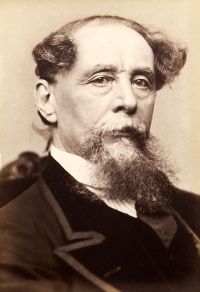 Charles Dickens,
Barnaby Rudge — Chapter 12
(1841)
Charles Dickens,
Barnaby Rudge — Chapter 12
(1841)
“ I’m very fond of Ned. He’s an amazingly good fellow, and a handsome fellow—foolish and weak as yet; that’s all. But the thing is, Haredale—for I’ll be very frank, as I told you I would at first—independently of any dislike that you and I might have to being related to each other, and independently of the religious differences between us—and damn it, that’s important—I couldn’t afford a match of this description. Ned and I couldn’t do it. It’s impossible.’‘Curb your tongue, in God’s name, if this conversation is to last,’ retorted Mr Haredale fiercely. ‘I have said I love my niece. ”
Charles Dickens,
Barnaby Rudge
(1841)
“ We must leave the discovery of this mystery, like all others, to time, and accident, and Heaven’s pleasure.’ ‘Varden, my good fellow,’ said Mr Haredale, ‘I have a deeper meaning in my present anxiety to find them out, than you can fathom. ”
Charles Dickens,
Barnaby Rudge
(1841)
“ The warrant being made out, three of the thief-takers bound him afresh (he had been struggling, it seemed, in the chaise, and had loosened his manacles) ; gagged him lest they should meet with any of the mob, and he should call to them for help; and seated themselves, along with him, in the carriage. These men being all well armed, made a formidable escort; but they drew up the blinds again, as though the carriage were empty, and directed Mr Haredale to ride forward, that he might not attract attention by seeming to belong to it. ”
Charles Dickens,
Barnaby Rudge
(1841)
“ Langdale—that’s my name—vintner and distiller—Holborn Hill—you’re heartily welcome, if you’ll come.’ Mr Haredale bowed, and rode off, close beside the chaise as before; determining to repair to the house of Sir John Fielding, who had the reputation of being a bold and active magistrate, and fully resolved, in case the rioters should come upon them, to do execution on the murderer with his own hands, rather than suffer him to be released. ”
Charles Dickens,
Barnaby Rudge — Chapter 20
(1841)
“ Not feeling quite certain, as she afterwards said, whether he might not be ‘coming over her’ with these compliments, Dolly kept as far from him as she could, cried again, and resolved to defend her pocket (for the letter was there) to the last extremity.‘I have some design,’ said Mr Haredale after a short silence, during which a smile, as he regarded her, had struggled through the gloom and melancholy that was natural to his face, ‘of providing a companion for my niece; for her life is a very lonely one. ”
Various, Graham's Magazine, Vol. XX, No… (1842)
“ They suggested the opinion that Haredale himself would be implicated in the murder, and that the counsellings alluded to might be those of that gentleman with Rudge. It is by no means impossible that some such conception wavered in the mind of the author. At page 32 we have a confirmation of our idea, when Varden endeavors to arrest the murderer in the house of his wife— “Come back—come back!” exclaimed the woman, wrestling with and clasping him. “Do not touch him on your life. He carries other lives beside his own.” ”
Charles Dickens,
Barnaby Rudge — Chapter 12
(1841)
“ You are a smooth man of the world, sir, and at such play have me at a disadvantage. The very last man on this earth with whom I would enter the lists to combat with gentle compliments and masked faces, is Mr Chester, I do assure you. I am not his match at such weapons, and have reason to believe that few men are.’‘You do me a great deal of honour Haredale,’ returned the other, most composedly, ‘and I thank you. ”
Charles Dickens,
Barnaby Rudge — Chapter 12
(1841)
“ But it may not have its own free time—will not, if they are left alone—and the question is, shall we two, because society calls us enemies, stand aloof, and let them rush into each other’s arms, when, by approaching each other sensibly, as we do now, we can prevent it, and part them?’‘I love my niece,’ said Mr Haredale, after a short silence. ‘It may sound strangely in your ears; but I love her.’‘Strangely, my good fellow!’ cried Mr Chester, lazily filling his glass again, and pulling out his toothpick. ‘Not at all. ”
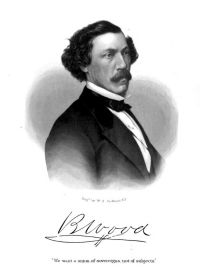 Benjamin Wood,
Fort Lafayette or, Love and Secession…
Benjamin Wood,
Fort Lafayette or, Love and Secession…
“ With all his strength, Harold drew the fierce brute toward him, circling his neck tightly with his left arm, and pressed the sharp blade against his throat. The hot blood gushed out over his hand, but he drove the weapon deeper, slitting the sinewy flesh to the right and left, till the dog ceased to struggle. Then Harold flung the huge carcass from him, and struck out, breathless as he was, for the schooner. It was time, for already his pursuers were upon the bank, aiming their pistol shots at the black spot which they could just distinguish cleaving through the water. ”
Baron Edward Bulwer Lytton Lytton, Harold : the Last of the Saxon Kings…
“ And still, amidst all those men of mark and might, Harold, simple and calm, looked as he had looked on his war-ship in the Thames, the man who could lead them all!From those, indeed, who were fortunate enough to see him as he passed up by the side of William, as tall as the Duke, and no less erect—of far slighter bulk, but with a strength almost equal, to a practised eye, in his compacter symmetry and more supple grace,—from those who saw him thus, an admiring murmur rose; for no men in the world so valued and cultivated personal advantages as the Norman knighthood. ”
Charles Dickens,
A Child's History of England
“ Harold was now King all over England, though it is doubtful whether the Archbishop of Canterbury (the greater part of the priests were Saxons, and not friendly to the Danes) ever consented to crown him. Crowned or uncrowned, with the Archbishop’s leave or without it, he was King for four years: after which short reign he died, and was buried; having never done much in life but go a hunting. He was such a fast runner at this, his favourite sport, that the people called him Harold Harefoot. ”
A. L. O. E., Harold's Bride: A Tale
“ But first I must tell you what I think of Harold’s father, though I have seen but little of him as yet. Mr. Hartley is tall, but stoops slightly, as if from weakness. He is pale and thin and somewhat wrinkled—less from age, I think, than from toil. Harold has certainly a likeness to his parent; but, oh! I trust that my noble-looking husband, whose form is so erect, whose step so elastic, may never have such a worn-out appearance, such a faint voice, as the veteran worker. ”
Hilda T. Skae, Stories from English History
“ The door was thrown open, and a weary, white-faced man appeared, all splashed and caked with mud. 'What ill news have you come to bring me?' asked Harold, while the others all left the board and crowded round to hear. 'My lord the king,' said the messenger, 'I am from Pevensey—the Normans have landed—Duke William—sixty thousand men—laying waste the country—ships, horses, men-at-arms——' 'Ha!' said Harold; 'he has chosen a time when the men who guard the coast are at their harvest; scattered over the country; and there is no one save myself to gather them together. ”
1911 Encyclopædia Britannica, Volume 13… (1911)
“ He was now the chief man in the kingdom, and when the older earls Leofric and Siward died his power increased yet more, and the latter part of Edward’s reign was virtually the reign of Harold. In 1055 he drove back the Welsh, who had burned Hereford. In 1063 came the great Welsh war, in which Harold, with the help of his brother Tostig, crushed the power of Gruffyd, who was killed by his own people. But in spite of his power and his prowess, Harold was the minister of the king rather than his personal favourite. ”
Freeman Bunting, Harold's Town and Its Vicinity
“ From the Abbey fields, the finest view of Harold’s noble minster is obtained, and it is with feelings of pleasant anticipation that one retraces one’s steps thereto, meditating on the way upon the many strange and wondrous scenes that have been witnessed on the ground over which one passes. ”
Baron Edward Bulwer Lytton Lytton, Harold : the Last of the Saxon Kings…
“ But if Harold had ruled no earldom at all, he had still been immeasurably the first man in England—so great was the confidence reposed in his valour and wisdom. He was of that height in himself, that he needed no pedestal to stand on.The successor of the first great founder of a House succeeds to more than his predecessor's power, if he but know how to wield and maintain it. For who makes his way to greatness without raising foes at every step? ”
Henry James, Lady Barbarina, The Siege of London…
“ All of which is very uncomfortable, and I daresay will be worse at Hyères. There, however, fortunately, we shall have our own people.There are some very odd Americans here who keep throwing Harold into fits of laughter. One’s a dreadful little man whom indeed he also wants to kick and who’s always sitting over the fire and talking about the colour of the sky. I don’t believe he ever saw the sky except through the window-pane. The other day he took hold of my frock—that green one you thought so nice at Homburg—and told me that it reminded him of the texture of the Devonshire turf. ”
Baron Edward Bulwer Lytton Lytton, Harold : the Last of the Saxon Kings…
“ When, after the death of that truculent and orgulous Godwin, King Edward entreated Harold to let him have back some of his dear Norman favourites, thou, then little pleased with the plain fare and sharp discipline of the convent of Bec, didst pray Bishop William of London to accompany such train as Harold, moved by his poor king's supplication, was pleased to permit. The bishop consented, and thou wert enabled to change monk's cowl for abbot's mitre. In a word, ambition brought thee to England, and ambition brings me hither. ”
 Charles Kingsley,
Hereward, the Last of the English
Charles Kingsley,
Hereward, the Last of the English
“ Harold has large manors in Lincolnshire, and so has Edith his sister; and what of them, Sir Hereward?” “That the man who touches them, even though the men on them may fight on Harold’s side, had better have put his head into a hornet’s nest. Unjustly were they seized from their true owners by Harold and his fathers; and the holders of them will owe no service to him a day longer than they can help; but will, if he fall, demand an earl of their own race, or fight to the death.” “Best make young Waltheof earl, then.” ”
Anonymous, The Cornish Fishermen's Watch-Night…
“ In one of the baronial halls of England lived Harold, a celebrated jester. He was a faithful servant, and a great favourite in the family. His master was so pleased with his drollery that on one occasion he gave him a white wand, saying, "There, Harold, keep that as your staff of office, till you find a greater fool than yourself, and then you may give it to him." ”
Hilda T. Skae, Stories from English History
“ Harold, Earl of Wessex, the king's brother-in-law, was one of the most able men then living; a true Englishman, wise and honourable. The people of England loved and trusted Harold; and as Edward had no children to succeed to the throne, they hoped that after his death Harold would become their king. On the other side of the strip of sea which divides England from France, there lived at this time a very proud and ambitious man, William, Duke of Normandy. ”
A. L. O. E., The Hartley brothers (1889)
“ The man had mistaken the meaning of the question, and thought that Harold was inquiring whether he himself had brother or wife in the place."I will seek them out," said Harold; and he was about to try to make his way amongst tent-pins and over tent-ropes, when he was caught in the grasp of Miss Petty. It was a desperate grasp."Oh, don't leave me, Harold; for pity's sake don't leave me," she cried. "I am almost dead; I cannot walk a single step; my poor head is splitting with pain. Robin is sure to look after Mrs. Evendale—he always does. ”
Henry St. John Cooper, The Garden of Memories
“ Thought you'd like to see Harold again, hey? By the way he is Sir Harold now, Governor of somewhere or other. The world's treated him decently, yes decently, eh Harold? And quite right too, I like to see a man work his way up in the world.""I am glad to hear it," Kathleen said. "I am sure that any fortune that has come to Mr. Scar—to Sir Harold Scarsdale, has been fairly and honestly won—and thoroughly deserved.""Ha, ha, nicely put, very simply and nicely put, eh Scarsdale?" said his lordship. "Give me your arm, my dear, I'm confoundedly cramped, getting to be an old fellow now. ”
Baron Edward Bulwer Lytton Lytton, Harold : the Last of the Saxon Kings…
“ At dawn, Harold woke from uneasy and broken slumbers, and his eyes fell upon the face of Hilda, large, and fair, and unutterably calm, as the face of Egyptian sphinx. “Have thy dreams been prophetic, son of Godwin?” said the Vala. “Our Lord forfend,” replied the Earl, with unusual devoutness. “Tell them, and let me read the rede; sense dwells in the voices of the night.” ”
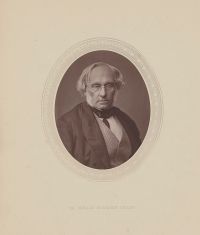 Edward Shepherd Creasy,
The Fifteen Decisive Battles of the World
(1851)
Edward Shepherd Creasy,
The Fifteen Decisive Battles of the World
(1851)
“ Harold, once more taken by surprise, and not able to deny his former words, approached the missal, and laid his hand on it, not knowing that the chest of relics was beneath. The old Norman chronicler, who describes the scene most minutely, [7] says, when Harold placed his hand on it, the hand trembled, and the flesh quivered; but he swore, and promised upon his oath, to take Ele [8] to wife, and to deliver up England to the Duke, and thereunto to do all in his power, according to his might and wit, after the death of Edward, if he himself should live: so help him God. ”
Freeman Bunting, Harold's Town and Its Vicinity
“ On the site of Tovi’s foundation Earl Harold, upon whom Waltham and vast lands had been bestowed by Edward the Confessor, reared and endowed a magnificent church, which he intended to rival in beauty and importance King Edward’s abbey church at Westminster. The dean and twelve secular Black canons who formed the ecclesiastical constitution of Harold’s foundation, were amply provided for, each of the latter having a manor and the dean six manors for his maintenance. ”
