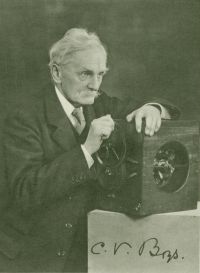
Charles Vernon Boys

Charles Vernon Boys

Summary

Portrait of Charles Vernon Boys Charles Vernon Boys Encyclopædia Britannica, Ninth Edition (1888)

Owing to the inconvenience caused by doorways being often too narrow to allow a tricycle to pass through, many machines are made to fold up into a narrower space or to shut up like a telescope.
It is important that the rider should be so placed that he can, without leaning forward, put most of his weight on the treadles, and this is more than ever needed as the steepness of an ascent in creases, because the slope of the machine has a contrary effect.
Source: Wikisource

Portrait of Charles Vernon Boys Charles Vernon Boys Encyclopædia Britannica, Ninth Edition (1888)

Sociable machines are both front-steering and rear-steering. Rear-steerers with each rider driving the wheel on his side only are nearly as objectionable as the single-driving rear-steerer. Front-steering sociables with dif ferential gear are safe and comfortable; but all sociables are slow machines. For nearly every make of single tricycle there is a corresponding tandem. The Coventry rotary in the tandem form suffers more from the single-side driving than in the single form, the rear-steering machines not so much, owing to the greater weight which the steering wheel has to bear.
Source: Wikisource

Portrait of Charles Vernon Boys Charles Vernon Boys Encyclopædia Britannica, Ninth Edition (1888)

The differential gear is an essential feature of the modern tricycle.
In 1878 Messrs Doubleday and Humber patented the Humber machine, which is both driven and steered by the two front wheels, the rider being seated on a trailing backbone and hind wheel as in the bicycle. This machine requires skill to manage: the steering is at first difficult to control and a spill over the handles is quite possible; under a skilful rider, however, the Humber is generally recognized as one of the fastest machines.
Source: Wikisource

Get perspective with Kwize: daily news enlightened by great literature