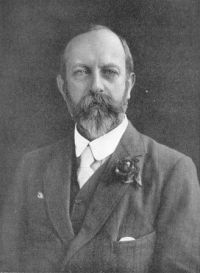
Edward Alfred Minchin

Edward Alfred Minchin

Summary

Portrait of Edward Alfred Minchin Edward Alfred Minchin 1911 Encyclopædia Britannica, Volume 22… (1911)

It is an almost universal attribute of polyps to possess the power of “reproducing themselves non-sexually by the method of budding. This mode of reproduction may be combined with sexual reproductiveness, or may be the sole method by which the polyp produces offspring, in which case the polyp is entirely without sexual organs. In many cases the buds formed do not separate from the parent but remain in continuity with it, thus forming colonies or stocks, which may reach a great size and contain a vast number of individuals.
Source: Wikisource

Portrait of Edward Alfred Minchin Edward Alfred Minchin 1911 Encyclopædia Britannica, Volume 22… (1911)

It cannot be too emphatically stated that a coral-polyp is as far removed in organization from either an octopus or an insect as it is from man himself.
The external form of the polyp varies greatly in different cases. In the first place the column may be long and slender, or may be, on the contrary, so short in the vertical direction that the body becomes disk-like. The tentacles may number many hundreds or may be very few, in rare cases only one or two, or even absent altogether; they may be long and filamentous, or short and reduced to mere knobs or warts
Source: Wikisource

Portrait of Edward Alfred Minchin Edward Alfred Minchin 1911 Encyclopædia Britannica, Volume 22… (1911)

Between ectoderm and endoderm is a supporting layer of structureless gelatinous substance termed mesogloea, secreted by the cell-layers of the body-wall; the mesogloea may be a very thin layer, or may reach a fair thickness, and then sometimes contains skeletal elements formed by cells which have migrated into it from the ectoderm.
Source: Wikisource

Get perspective with Kwize: daily news enlightened by great literature