Summary

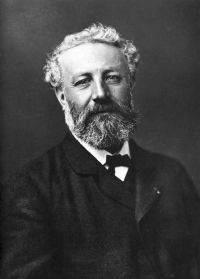
Portrait of Jules Verne Jules Verne 20,000 Leagues Under the Seas… (1870)

At this locality we stood in the center of a huge clearing surrounded by the tall tree forms of this underwater forest. Our lamps cast a sort of brilliant twilight over the area, making inordinately long shadows on the seafloor. Past the boundaries of the clearing, the darkness deepened again, relieved only by little sparkles given off by the sharp crests of coral.
Source: Wikisource

Portrait of Jules Verne Jules Verne 20,000 Leagues Under the Seas… (1870)

The double door opened, and accompanied by Captain Nemo with a dozen crewmen following, we set foot on the firm seafloor where the Nautilus was resting, ten meters down.
A gentle slope gravitated to an uneven bottom whose depth was about fifteen fathoms. This bottom was completely different from the one I had visited during my first excursion under the waters of the Pacific Ocean. Here I saw no fine–grained sand, no underwater prairies, not one open–sea forest. I immediately recognized the wondrous region in which Captain Nemo did the honors that day. It was the coral realm.
Source: Wikisource

Portrait of Jules Verne Jules Verne 20,000 Leagues Under the Seas… (1870)

Amid these shrubs of precious coral, I observed other polyps no less unusual: melita coral, rainbow coral with jointed outgrowths, then a few tufts of genus Corallina, some green and others red, actually a type of seaweed encrusted with limestone salts, which, after long disputes, naturalists have finally placed in the vegetable kingdom. But as one intellectual has remarked, "Here, perhaps, is the actual point where life rises humbly out of slumbering stone, but without breaking away from its crude starting point."
Source: Wikisource

Get perspective with Kwize: daily news enlightened by great literature