Summary

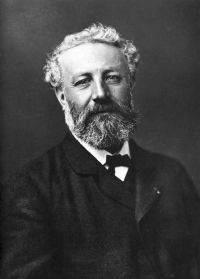
Portrait of Jules Verne Jules Verne 20,000 Leagues Under the Seas… (1870)

I was marveling at this magnificent ocean view when Captain Nemo appeared. He didn't seem to notice my presence and began a series of astronomical observations. Then, his operations finished, he went and leaned his elbows on the beacon housing, his eyes straying over the surface of the ocean.
Meanwhile some twenty of the Nautilus's sailors—all energetic, well–built fellows—climbed onto the platform. They had come to pull up the nets left in our wake during the night.
Source: Wikisource

Portrait of Jules Verne Jules Verne 20,000 Leagues Under the Seas… (1870)

And so, after they've finished depriving our water drop of its mineral nutrients, the droplet gets lighter, rises to the surface, there absorbs more salts left behind through evaporation, gets heavier, sinks again, and brings those tiny animals new elements to absorb. The outcome: a double current, rising and falling, constant movement, constant life! More intense than on land, more abundant, more infinite, such life blooms in every part of this ocean, an element fatal to man, they say, but vital to myriads of animals—and to me!
Source: Wikisource

Portrait of Jules Verne Jules Verne 20,000 Leagues Under the Seas… (1870)

We stared at them through our thick glass windows: they swam backward with tremendous speed, moving by means of their locomotive tubes, chasing fish and mollusks, eating the little ones, eaten by the big ones, and tossing in indescribable confusion the ten feet that nature has rooted in their heads like a hairpiece of pneumatic snakes. Despite its speed, the Nautilus navigated for several hours in the midst of this school of animals, and its nets brought up an incalculable number, among which I recognized all nine species that Professor Orbigny has classified as native to the Pacific Ocean.
Source: Wikisource

Get perspective with Kwize: daily news enlightened by great literature