Summary

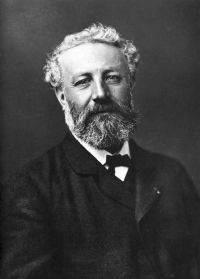
Portrait of Jules Verne Jules Verne 20,000 Leagues Under the Seas… (1870)

The electric cells you use to generate this marvelous force must be depleted very quickly. Their zinc component, for example: how do you replace it, since you no longer stay in contact with the shore?"
"That question deserves an answer," Captain Nemo replied. "First off, I'll mention that at the bottom of the sea there exist veins of zinc, iron, silver, and gold whose mining would quite certainly be feasible. But I've tapped none of these land–based metals, and I wanted to make demands only on the sea itself for the sources of my electricity."
Source: Wikisource

Portrait of Jules Verne Jules Verne 20,000 Leagues Under the Seas… (1870)

Meanwhile I examined the Nautilus's engine with a fascination easy to imagine.
"You observe," Captain Nemo told me, "that I use Bunsen cells, not Ruhmkorff cells. The latter would be ineffectual. One uses fewer Bunsen cells, but they're big and strong, and experience has proven their superiority. The electricity generated here makes its way to the stern, where electromagnets of huge size activate a special system of levers and gears that transmit movement to the propeller's shaft. The latter has a diameter of 6 meters, a pitch of 7.5 meters, and can do up to 120 revolutions per minute."
Source: Wikisource

Get perspective with Kwize: daily news enlightened by great literature